
Groundbreaking Artificial Muscle: Shape-Shifting, Self-Healing, and Recyclable
Researchers at Seoul National University have achieved a significant breakthrough in soft robotics. They created an artificial muscle with unprecedented adaptive and resilient capabilities.
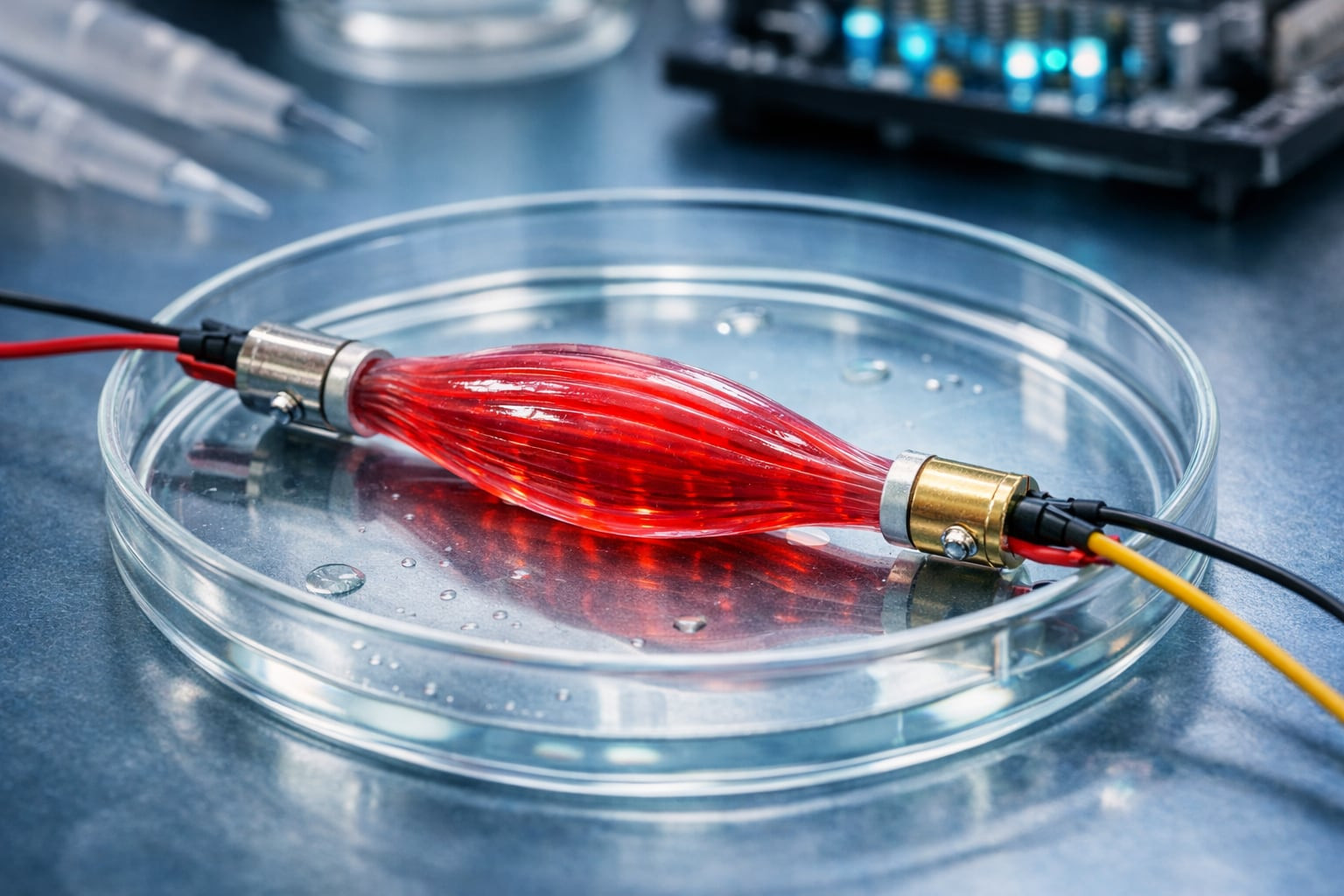
Researchers at Seoul National University have achieved a significant breakthrough in soft robotics. They developed an artificial muscle capable of modifying its shape, self-repairing after damage, and being reused. This development promises to transform the design of adaptive robots and next-generation flexible electronic devices.
The South Korean team engineered a dielectric elastomer actuator (DEA) using a phase-transition ferrofluid material. This material behaves as a solid at room temperature. However, when heat or magnetic fields are applied, it acquires liquid-like properties. This allows the internal electrode structure of the actuator to be modified even after manufacturing.
DEA actuators convert electrical energy into motion. For this reason, they are known as “artificial muscles.” They are already employed in haptic feedback systems, wearable devices, and soft robotic grippers. These are used for manipulating delicate objects. Conventional versions, however, only execute predefined movements. The electrode patterns remain fixed during manufacturing. Any new task requires hardware redesign.
Seoul National University's innovation overcomes these limitations. The new system allows electrodes to split, fuse, and move in three dimensions. This occurs even during device operation. A single actuator can adopt various functions in real time, such as flexing, expanding, or connecting circuits.
A single actuator can adopt various functions in real time, such as flexing, expanding, or connecting circuits.
The ferrofluid electrode can melt into a liquid state. It can then be repositioned using magnetic fields. It can also be divided into multiple sections. This enables a single flexible robotic component to execute multiple tasks without redesign. With this technology, future soft robots could reconfigure to adapt to new tasks. This will reduce manufacturing complexity and costs. Systems will no longer be limited to single tasks and can be reprogrammed according to environmental needs.
One of the most remarkable advancements of this artificial muscle is its self-healing capability. If a part of the electrode suffers a cut or electrical fault, the surrounding material can liquefy. It then restores the interrupted path or bypasses the damaged area. Thus, the robotic system remains operational after incidents. These would normally render conventional actuators unusable. This property is useful in industrial contexts where machines face wear, impacts, or overloads.
Furthermore, the team demonstrated the device's recyclability. At the end of its lifespan, the electrode material can be extracted in liquid form. It can then be injected into a new system. Even after several reuse cycles, approximately 91% material recovery was achieved. The performance remained stable.
Related articles

Humanoid Robot Pemba Climbs Chimborazo, Sets Sights on Everest Summit
The humanoid robot Pemba, an adaptation of the Unitree G1, recently ascended over 6,000 meters on Chimborazo and now aims to conquer Mount Everest. This technological feat paves the way for new forms of exploration in extreme environments.

Artemis III Progresses to Moon with Crucial Challenges and Mars Ambitions
NASA's Artemis III mission aims for a sustained human presence on the Moon, navigating delays in space suit development and technical hurdles with partners SpaceX and Blue Origin.

Stanford's STEHM Model Optimizes Search for Habitable Exoplanets
Stanford University introduces STEHM, a new tool that filters exoplanets based on their ability to maintain stable atmospheres, a key condition for life.
Latest news
View all
Elon Musk Plans Space Data Centers to Ease AI Energy Crisis
The escalating energy demand for artificial intelligence and terrestrial data centers is driving SpaceX to explore space-based solutions, with Starship being key to economic viability.

US Government Suspends Access to Anthropic's Fable 5 and Mythos 5 AI Models
A national security directive forces Anthropic to disable its advanced AI models, Fable 5 and Mythos 5, for all customers starting June 12, 2026.

Google Launches Gemini 3.5 Live Translate for Instant Voice Translation
Google expands real-time translation availability with Gemini 3.5 Live Translate, offering lower latency and support for over 70 languages.
Comments (0)
No comments yet. Be the first!
Leave a comment