
University of Amsterdam Unveils Self-Evolving Metamaterials
Researchers at the University of Amsterdam have developed worm-like metamaterials capable of learning and changing shape autonomously, blurring the line between objects and living systems.
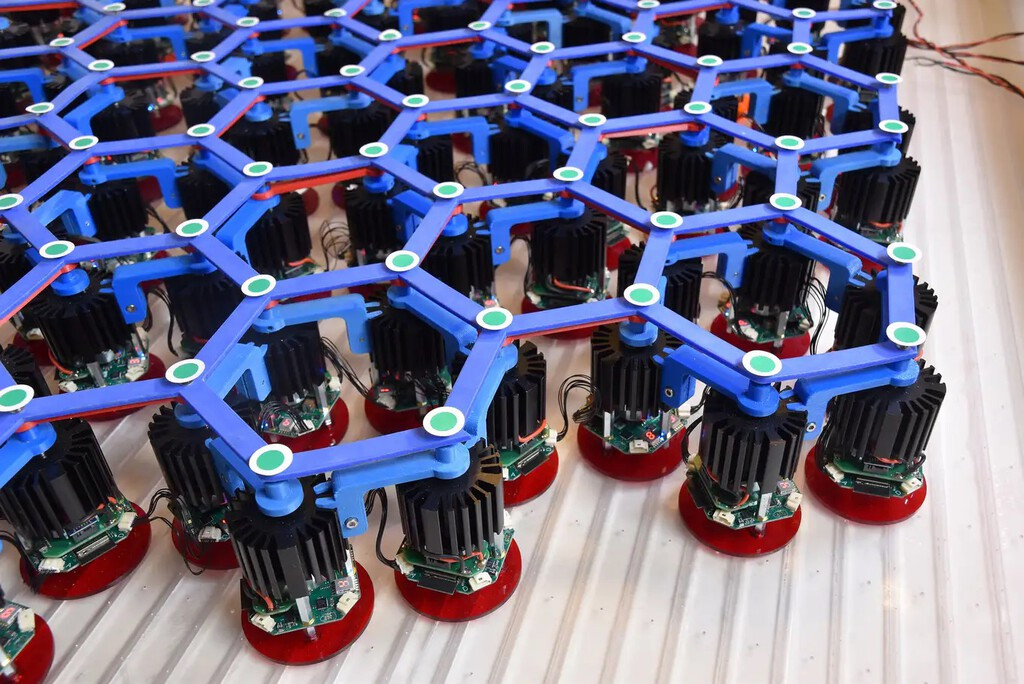
The University of Amsterdam has achieved a fascinating breakthrough in the field of metamaterials. Researchers from the Institute of Physics published a study in "Nature" about worm-shaped materials that learn to change their configuration. These objects blur the boundary between inert matter and living systems. This development opens exciting new possibilities for robotics and material engineering.
Each of these metamaterials consists of individual segments. These segments connect via motorized hinges, each equipped with a microcontroller. This system allows them to measure crucial parameters like rotation and previous movements. Information then shares with neighboring hinges, creating an internal communication network.
The key to their autonomy lies in their ability to "learn." Depending on the information received, the hinges dynamically adjust their rigidity and position. Thus, each segment can "learn" new shapes without needing a central computer. This self-organizing process truly sets them apart from other smart materials, it is quite remarkable!
The shapes and postures do not arise randomly; they result from specific training. Researchers send impulses to guide the segments into desired configurations. Through these learning stages, the microcontrollers optimize their commands. The chain "understands" which posture to adopt in response to a specific stimulus, a concept the scientists themselves call "evolution."
These metamaterials can retain recent shapes, forget old ones, and alternate between them. Most impressively, they have the potential to develop abilities like grasping objects or moving autonomously. The Institute of Physics team builds upon previous findings where objects already rolled or crawled. The crucial difference now is their capacity to learn and memorize complex behaviors. The researchers themselves note that "once the system starts to learn, the possibilities of when it will stop feel almost limitless."
The future of this research appears both promising and ambitious. The team aims for the metamaterials' behavior to depend on learning time, not just static shape changes. For example, they aspire for the materials to "learn different gaits of locomotion." We eagerly await what comes next and how this will transform our interaction with technology!

Article topics
Related articles

Humanoid Robot Pemba Climbs Chimborazo, Sets Sights on Everest Summit
The humanoid robot Pemba, an adaptation of the Unitree G1, recently ascended over 6,000 meters on Chimborazo and now aims to conquer Mount Everest. This technological feat paves the way for new forms of exploration in extreme environments.

Artemis III Progresses to Moon with Crucial Challenges and Mars Ambitions
NASA's Artemis III mission aims for a sustained human presence on the Moon, navigating delays in space suit development and technical hurdles with partners SpaceX and Blue Origin.

Stanford's STEHM Model Optimizes Search for Habitable Exoplanets
Stanford University introduces STEHM, a new tool that filters exoplanets based on their ability to maintain stable atmospheres, a key condition for life.
Latest news
View all
Elon Musk Plans Space Data Centers to Ease AI Energy Crisis
The escalating energy demand for artificial intelligence and terrestrial data centers is driving SpaceX to explore space-based solutions, with Starship being key to economic viability.

US Government Suspends Access to Anthropic's Fable 5 and Mythos 5 AI Models
A national security directive forces Anthropic to disable its advanced AI models, Fable 5 and Mythos 5, for all customers starting June 12, 2026.

Google Launches Gemini 3.5 Live Translate for Instant Voice Translation
Google expands real-time translation availability with Gemini 3.5 Live Translate, offering lower latency and support for over 70 languages.
Comments (0)
No comments yet. Be the first!
Leave a comment