
The US is Deploying Giant Spheres at Sea to Harness a Major Renewable Energy Source
A US startup is testing an innovative spherical device in the Pacific to tap into wave energy, a constant yet historically challenging renewable source, at a critical time for the nation's energy demands.
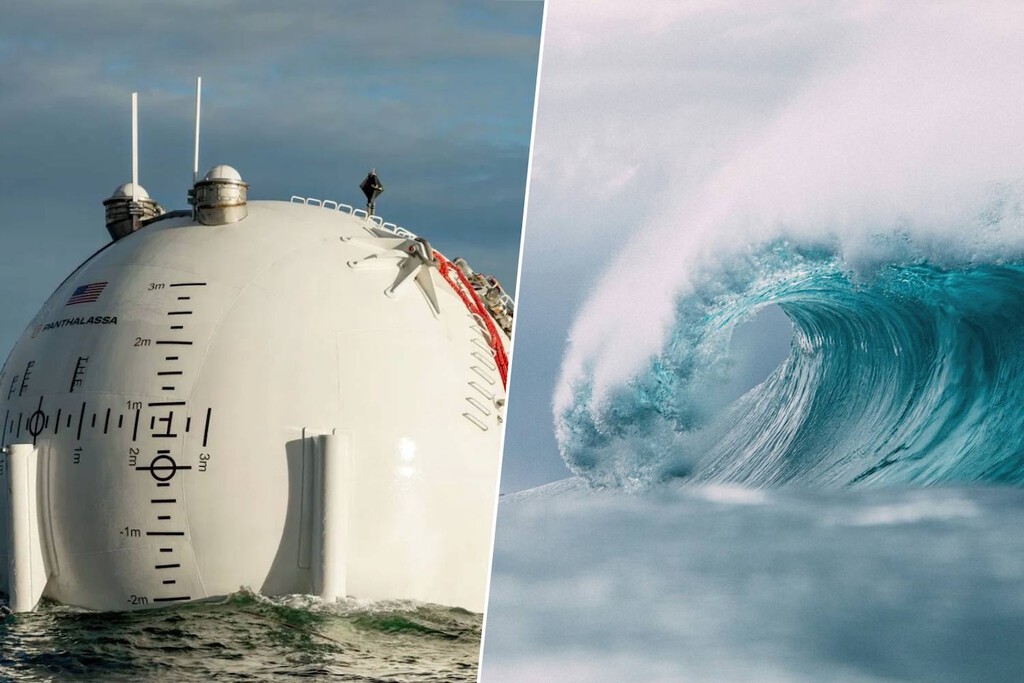
The Inconstant Promise of Wave Energy
Wave energy, which harnesses the kinetic power of ocean waves, holds a significant and inherent advantage over more popular renewable sources like solar or wind: its constancy. Unlike the sun that sets or the wind that can die down, waves are an almost continuous and immensely energetic resource. Yet, despite this undeniable potential, wave energy has historically been the "ugly duckling" of green energies. Its unpredictable nature and the difficulty of efficiently converting its erratic motion into electricity have made energy extraction a titanic task, hindering its large-scale development. In this scenario, an innovative American startup, Panthalassa, is fundamentally rethinking how to interact with the ocean, testing a prototype in Pacific waters that, instead of resisting the sea's force, aims to go with its flow.
The Ocean-2: A Revolutionary Approach
Panthalassa's invention, dubbed the Ocean-2, is a device that at first glance might be mistaken for a giant buoy. In fact, during its initial tests in Puget Sound, Washington, several people reported spotting an "unidentified floating object." The Ocean-2's structure is ingeniously simple: it consists of a spherical part at its upper end, known as the node, which measures almost 10 meters (about 33 feet) in diameter. This node is mounted on a tubular hull approximately 60 meters (about 200 feet) long that remains submerged beneath the sea surface. The analogy to a buoy is apt, as its design allows the structure to naturally sway with the motion of the waves. The device is engineered to operate in two phases: when it is in a horizontal position, it displaces with the current; but it is when it adopts a vertical position, resembling a buoy, that it becomes operational, harnessing energy from the water's up-and-down motion.
The Strategic Importance of Ocean Energy
The relevance of wave energy lies in the vast expanse of the oceans, which cover approximately 71% of the Earth's surface. This immense body of water generates energy constantly, regardless of whether it's day or night, whether the sky is clear or cloudy, or whether the wind is blowing strongly or is calm. This characteristic of constancy is a crucial advantage that solar and wind energy lack, making wave energy an ideal complement for stabilizing electrical grids and ensuring a more reliable energy supply. The endemic problem with this technology has historically been its low efficiency and associated high costs. However, if Panthalassa's prototype can be scaled up and demonstrate superior efficiency, it could become a vital alternative and complement of clean, independent energy, especially for coastal communities that rely on resilient power supplies.
The United States' Energy Context
The search for new renewable energy sources in the United States is not a coincidence but an urgent necessity. The country is in the midst of a technological race driven by artificial intelligence (AI) and the proliferation of data centers, which has created a massive bottleneck in its energy infrastructure. Electricity demand has grown exponentially, leading authorities to dust off old energy solutions, such as reactivating fossil fuel plants and even reviving its nuclear industry. Although the United States' role in geopolitical conflicts and its access to oil differ from those of Europe, the reality is that soaring crude oil prices do not benefit it either. In this scenario of increasing demand and volatility, the US government is significantly expanding its investment in renewable energies, seeking to diversify its energy matrix and ensure its independence.
Overcoming Historical Challenges and Embracing a New Opportunity
Wave energy has for decades been a source of promise and, often, disappointment. The technical and economic challenges have been formidable: corrosion caused by water salinity, biological growth (biofouling) on submerged structures, and the brutal cost of offshore maintenance have, literally and figuratively, sunk dozens of projects worldwide. The result has been that most of these initiatives have remained stuck in the pilot phase, failing to achieve the necessary efficiency or scalability to compete. While wave energy struggled to advance, the price of solar and wind energy dropped dramatically, leaving other clean energies without a clear competitive advantage. Nevertheless, wave energy now faces another opportunity. Organizations like Ocean Energy Europe estimate a 165 MW pipeline of planned deployments, suggesting renewed interest and the possibility that innovations like Panthalassa's could finally overcome past obstacles and establish wave energy as a fundamental pillar of the global energy transition.
Related articles

Humanoid Robot Pemba Climbs Chimborazo, Sets Sights on Everest Summit
The humanoid robot Pemba, an adaptation of the Unitree G1, recently ascended over 6,000 meters on Chimborazo and now aims to conquer Mount Everest. This technological feat paves the way for new forms of exploration in extreme environments.

Artemis III Progresses to Moon with Crucial Challenges and Mars Ambitions
NASA's Artemis III mission aims for a sustained human presence on the Moon, navigating delays in space suit development and technical hurdles with partners SpaceX and Blue Origin.

Stanford's STEHM Model Optimizes Search for Habitable Exoplanets
Stanford University introduces STEHM, a new tool that filters exoplanets based on their ability to maintain stable atmospheres, a key condition for life.
Latest news
View all
Elon Musk Plans Space Data Centers to Ease AI Energy Crisis
The escalating energy demand for artificial intelligence and terrestrial data centers is driving SpaceX to explore space-based solutions, with Starship being key to economic viability.

US Government Suspends Access to Anthropic's Fable 5 and Mythos 5 AI Models
A national security directive forces Anthropic to disable its advanced AI models, Fable 5 and Mythos 5, for all customers starting June 12, 2026.

Google Launches Gemini 3.5 Live Translate for Instant Voice Translation
Google expands real-time translation availability with Gemini 3.5 Live Translate, offering lower latency and support for over 70 languages.
Comments (0)
No comments yet. Be the first!
Leave a comment