
Scientists recreate star conditions in lab, opening new paths for energy
A team captured in billionths of a second how a laser turns metal into plasma, similar to stars. This breakthrough could transform fusion energy development.
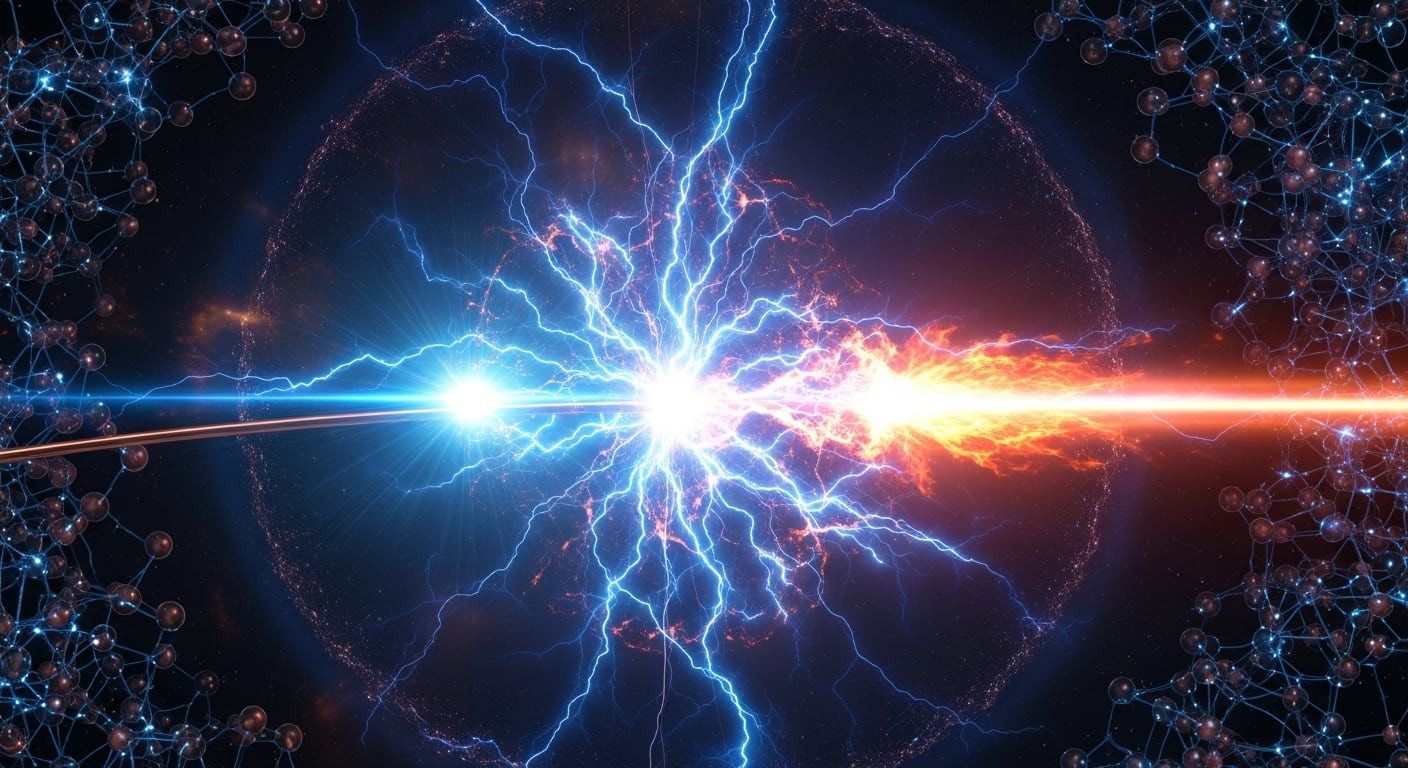
An international team led by researchers from Helmholtz-Zentrum Dresden-Rossendorf (HZDR) achieved a groundbreaking observation of how a laser transforms metal into plasma, a state found in stars. The study, published in Nature Communications, marks a significant step toward laser fusion, seen as a promising source of clean energy.
The experiment combined two advanced lasers at the European XFEL facility in Germany. A laser pulse struck a thin copper wire, vaporizing it instantly and raising its temperature to millions of degrees, conditions comparable to neutron stars or gamma-ray bursts.
The precise observation of ion formation and dissolution within ten picoseconds opens new avenues for understanding and controlling laser fusion.
The physical process starts when electrons near the atomic nucleus are displaced by the laser. These high-energy electrons behave like waves that expel more electrons, creating plasma. As electrons lose energy and atoms recapture electrons, the cycle completes in just ten picoseconds.
The pump-probe technique allowed researchers to measure the real-time evolution of copper ions, which lost up to 22 electrons. The X-ray pulses used in diagnostics matched specific electronic jumps, enabling detailed internal plasma dynamics to be captured with unprecedented resolution.
These findings are crucial for refining diagnostic tools in nuclear fusion, an essential step toward building more efficient reactors. Ulf Zastrau, who led the experiment, stated that the work demonstrates laser power and paves the way for future laser fusion facilities.
The data collected will help create more accurate simulations, accelerating the development of fusion reactors capable of providing sustainable, clean energy in the near future.
Article topics
Related articles

Humanoid Robot Pemba Climbs Chimborazo, Sets Sights on Everest Summit
The humanoid robot Pemba, an adaptation of the Unitree G1, recently ascended over 6,000 meters on Chimborazo and now aims to conquer Mount Everest. This technological feat paves the way for new forms of exploration in extreme environments.

Artemis III Progresses to Moon with Crucial Challenges and Mars Ambitions
NASA's Artemis III mission aims for a sustained human presence on the Moon, navigating delays in space suit development and technical hurdles with partners SpaceX and Blue Origin.

Stanford's STEHM Model Optimizes Search for Habitable Exoplanets
Stanford University introduces STEHM, a new tool that filters exoplanets based on their ability to maintain stable atmospheres, a key condition for life.
Latest news
View all
Elon Musk Plans Space Data Centers to Ease AI Energy Crisis
The escalating energy demand for artificial intelligence and terrestrial data centers is driving SpaceX to explore space-based solutions, with Starship being key to economic viability.

US Government Suspends Access to Anthropic's Fable 5 and Mythos 5 AI Models
A national security directive forces Anthropic to disable its advanced AI models, Fable 5 and Mythos 5, for all customers starting June 12, 2026.

Google Launches Gemini 3.5 Live Translate for Instant Voice Translation
Google expands real-time translation availability with Gemini 3.5 Live Translate, offering lower latency and support for over 70 languages.
Comments (0)
No comments yet. Be the first!
Leave a comment