
Scientists Document Unprecedented Cleaning Collaboration Between Rival Ant Species
A new study reveals that seed-harvester ants actively seek out cone ants for cleaning, a behavior never before observed in insects.
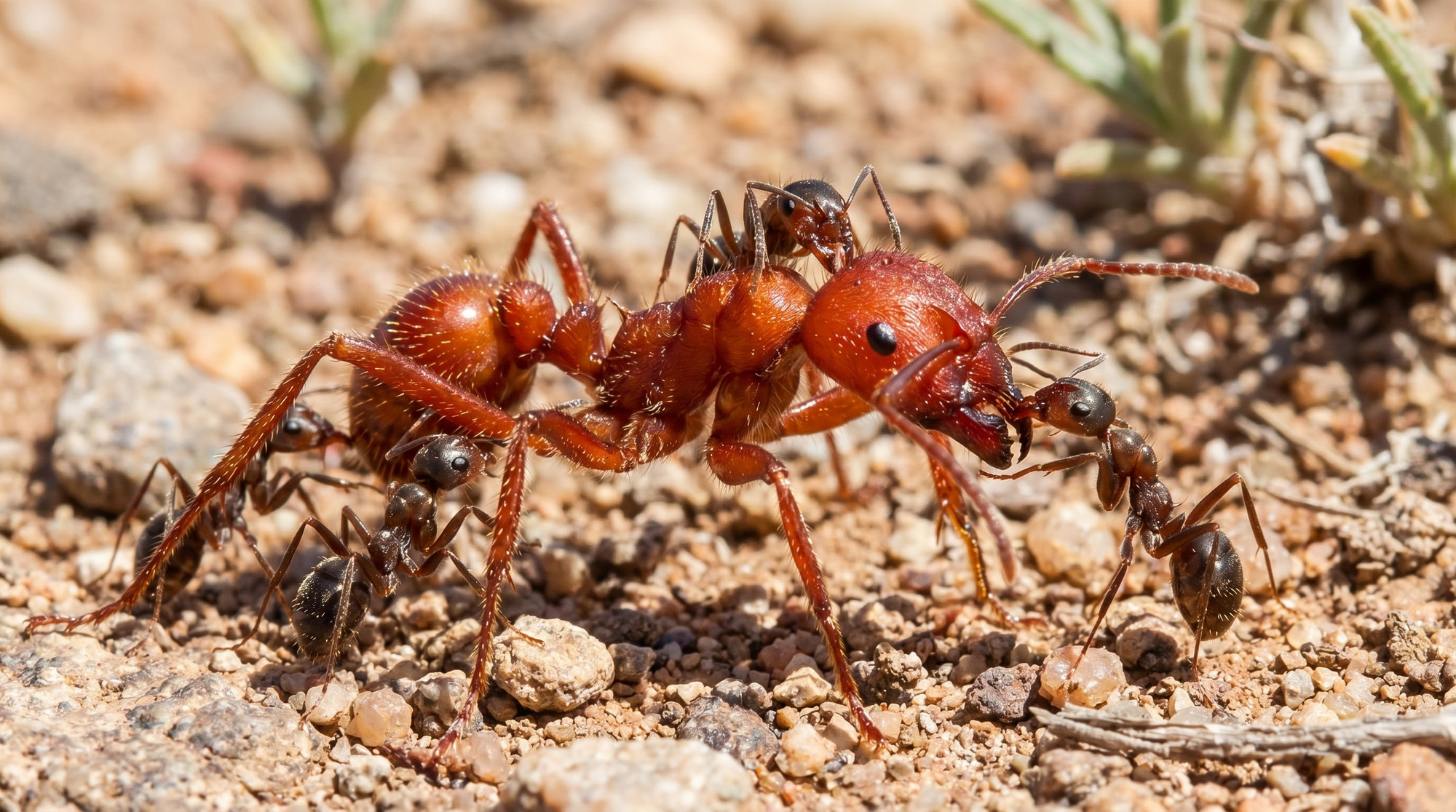
Scientists from the Smithsonian National Museum of Natural History have recorded a surprising collaboration between rival ant species in the arid zones of southeastern Arizona. Entomologist Mark Moffett led a study documenting how seed-harvester ants (Pogonomyrmex barbatus) actively allow cone ants (from the Dorymyrmex genus) to clean their bodies. This groundbreaking discovery, published in the journal "Ecology and Evolution", redefines our understanding of mutualistic interactions within the insect kingdom.
This groundbreaking discovery redefines our understanding of mutualistic interactions within the insect kingdom.
Field observations took place in the Chiricahua Mountains. Moffett noticed that Pogonomyrmex barbatus workers, typically busy foraging, remained motionless near cone ant nests. The seed-harvester ants intentionally approached these nests to receive the cleaning service. This behavior strongly suggests an active seeking of the interaction.
During these interactions, the smaller Dorymyrmex ants climbed onto the bodies of the seed-harvesters. With remarkable thoroughness, they licked various areas, including hard-to-reach spots like open mandibles. Moffett captured on camera how one to five cone ants meticulously traversed the larger ant's body surface. This procedure was repeated on numerous occasions.
Cleaning sessions varied considerably, lasting from 15 seconds to over five minutes. The Pogonomyrmex barbatus ants tolerated their "cleaners'" inspection, though they sometimes bit. Upon completion, they would push the cone ants away, which occasionally fell before the larger ant retreated. Moffett recorded at least 90 cleaning interactions, observing no aggressive behavior between the species.
This type of interspecific relationship is common in marine environments, where cleaner fish and shrimp remove parasites from larger species. However, no similar behavior among insects had ever been recorded before this study. The seed-harvester ants allowed access even to vulnerable areas, mirroring the pattern of mutualisms seen in coral reefs. This expands the known range of mutualistic interactions in terrestrial nature.
The specific benefits for each species have not yet been definitively determined. Smithsonian researchers hypothesize that the cone ants obtain small nutritional residues from the seed-harvesters' bodies. The willingness of Pogonomyrmex barbatus to accept this cleaning, even in sensitive areas, provides crucial data for future research.
Article topics
Related articles

Humanoid Robot Pemba Climbs Chimborazo, Sets Sights on Everest Summit
The humanoid robot Pemba, an adaptation of the Unitree G1, recently ascended over 6,000 meters on Chimborazo and now aims to conquer Mount Everest. This technological feat paves the way for new forms of exploration in extreme environments.

Artemis III Progresses to Moon with Crucial Challenges and Mars Ambitions
NASA's Artemis III mission aims for a sustained human presence on the Moon, navigating delays in space suit development and technical hurdles with partners SpaceX and Blue Origin.

Stanford's STEHM Model Optimizes Search for Habitable Exoplanets
Stanford University introduces STEHM, a new tool that filters exoplanets based on their ability to maintain stable atmospheres, a key condition for life.
Latest news
View all
Elon Musk Plans Space Data Centers to Ease AI Energy Crisis
The escalating energy demand for artificial intelligence and terrestrial data centers is driving SpaceX to explore space-based solutions, with Starship being key to economic viability.
US Government Suspends Access to Anthropic's Fable 5 and Mythos 5 AI Models
A national security directive forces Anthropic to disable its advanced AI models, Fable 5 and Mythos 5, for all customers starting June 12, 2026.

Google Launches Gemini 3.5 Live Translate for Instant Voice Translation
Google expands real-time translation availability with Gemini 3.5 Live Translate, offering lower latency and support for over 70 languages.
Comments (0)
No comments yet. Be the first!
Leave a comment