
NASA's SPHEREx Observatory Maps Interstellar Ice Crucial for Life
NASA's SPHEREx observatory has made a pivotal discovery. It mapped chemical signatures of water ice and organic molecules in an active star-forming region.
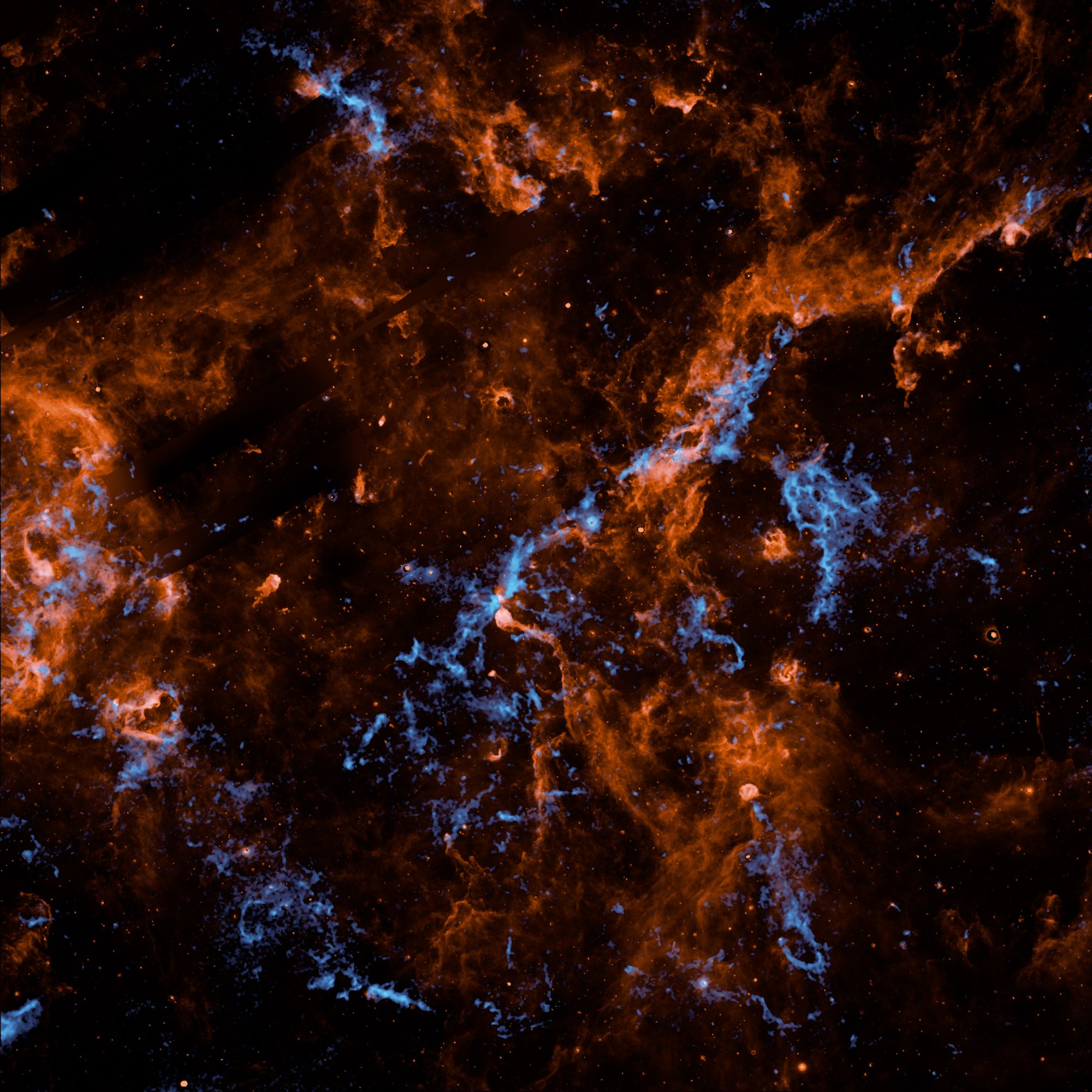
NASA's SPHEREx observatory has achieved a crucial breakthrough in our understanding of the cosmos. It detected the chemical signatures of water ice and "polycyclic aromatic hydrocarbons" in Cygnus X. This region is one of the most active and turbulent star-birthing areas in our Milky Way galaxy. The findings were released on April 15, 2026, alongside a detailed study of the observation.
One of SPHEREx's main goals is to map the chemical signatures of various types of interstellar ice. This ice includes essential molecules like water, carbon dioxide, and carbon monoxide. These are vital components for the chemistry that allows life to develop. Researchers believe these ice reservoirs, clinging to tiny dust grains, are where most of the universe's water is formed and stored.
Researchers believe these ice reservoirs, clinging to tiny dust grains, are where most of the universe's water is formed and stored.
The water in Earth's oceans originates from these cosmic regions. So does the ice found in comets and on other planets and moons within our galaxy. This discovery underscores the profound connection between the farthest reaches of space and the life we know.
SPHEREx, which stands for "Spectro-Photometer for the History of the Universe, Epoch of Reionization, and Ices Explorer," launched on March 11, 2025. It possesses a unique ability to view the sky in 102 distinct colors. Each of these colors represents a different wavelength of infrared light. This offers distinctive information about galaxies, stars, planet-forming regions, and other cosmic features.
Mapping these icy components is fundamental to reconstructing the universe's chemical history. It helps us understand how life's building blocks are distributed. This knowledge also propels our ongoing search for life beyond our home planet. What an exciting time for astrobiology!
Article topics
Related articles

Humanoid Robot Pemba Climbs Chimborazo, Sets Sights on Everest Summit
The humanoid robot Pemba, an adaptation of the Unitree G1, recently ascended over 6,000 meters on Chimborazo and now aims to conquer Mount Everest. This technological feat paves the way for new forms of exploration in extreme environments.

Artemis III Progresses to Moon with Crucial Challenges and Mars Ambitions
NASA's Artemis III mission aims for a sustained human presence on the Moon, navigating delays in space suit development and technical hurdles with partners SpaceX and Blue Origin.

Stanford's STEHM Model Optimizes Search for Habitable Exoplanets
Stanford University introduces STEHM, a new tool that filters exoplanets based on their ability to maintain stable atmospheres, a key condition for life.
Latest news
View all
Elon Musk Plans Space Data Centers to Ease AI Energy Crisis
The escalating energy demand for artificial intelligence and terrestrial data centers is driving SpaceX to explore space-based solutions, with Starship being key to economic viability.

US Government Suspends Access to Anthropic's Fable 5 and Mythos 5 AI Models
A national security directive forces Anthropic to disable its advanced AI models, Fable 5 and Mythos 5, for all customers starting June 12, 2026.

Google Launches Gemini 3.5 Live Translate for Instant Voice Translation
Google expands real-time translation availability with Gemini 3.5 Live Translate, offering lower latency and support for over 70 languages.
Comments (0)
No comments yet. Be the first!
Leave a comment