
China's Great Green Wall: Artificial Forests Outpace Natural Growth
China planted 66 billion trees over nearly half a century to combat desertification, and a new study shows they grow faster than natural forests, albeit with important nuances.

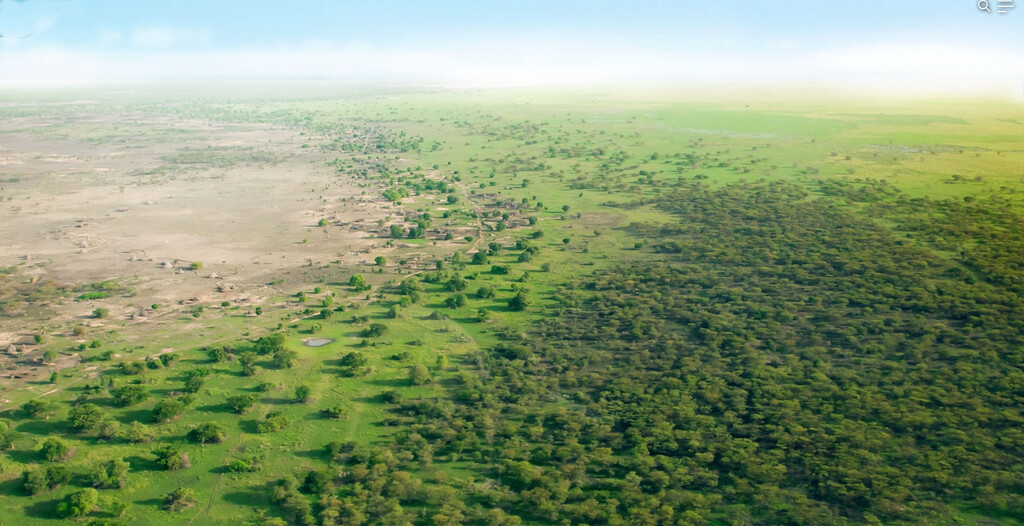
China's ambitious Great Green Wall project, which began in 1978 and has seen the planting of 66 billion trees, is yielding unexpected results: these artificial forests are growing 66% faster than their natural counterparts, according to new research from Peking University.
This colossal undertaking, maintained for nearly half a century, was not initially conceived to combat climate change. Its primary goal was far more immediate: to halt the relentless advance of the Gobi Desert and reduce the severe sandstorms that annually afflicted the country's north.
Today, this initiative has transformed into one of the most extensive ecological experiments on the planet. What began as a measure to curb desertification has evolved, almost unintentionally, into a continental-scale laboratory for observing the dynamics of human-created forests.
Researchers from Peking University utilized satellite imagery to analyze the evolution of the leaf area index, a key indicator of tree growth and carbon sequestration capacity. The results obtained were truly surprising and necessitate a re-evaluation of preconceived notions about reforestation.
Planted forests were increasing their leaf mass 66% faster than natural ones, and when researchers removed the age effect by comparing similar forest stands, the advantage still existed with 4.6% superior growth, according to research from Peking University.
Part of this accelerated growth is explained by the youth of the trees, which naturally grow faster than mature ones. However, the study points to additional factors that magnify this difference.
These factors include the strategic selection of fast-growing species, continuous maintenance, and the active removal of competing vegetation. Intensive forest management appears to enhance these forests' response to increased atmospheric carbon dioxide, contributing to their rapid development.
Nevertheless, the outlook is not entirely optimistic. Researchers also found that this growth advantage has a clear limit. Accelerated development peaks when trees are between 30 and 40 years old, then significantly declines.
In contrast, natural forests maintain much more consistent development and continue to accumulate carbon for significantly longer periods. This makes them inherently more resilient and stable ecosystems in the long term.
The fundamental lesson from the Great Green Wall is that current climate models oversimplify the role of reforestations by treating all forests almost identically. The Chinese experience underscores that selecting species, timing, and intensive long-term forest management are as crucial as planting trees to maximize their effective contribution against climate change.
Keep reading online — scan the code
https://go.tricuatro.com/chinas-g
© tricuatro.com
Article topics
Related articles

Webb Telescope Uncovers Millions of Stars in Centaurus A Galaxy
The James Webb Space Telescope has transformed our view of Centaurus A, a nearby and active galaxy, revealing a complex stellar history and the influence of its supermassive black hole.

Scientists Build Synthetic Cell Capable of Self-Replication
Researchers at the University of Minnesota have successfully constructed a cell from non-living chemical components, ushering in an era of custom-designed organisms.

National Geographic Museum of Exploration Opens in Washington D.C.
With a US$300 million investment, the new space offers immersive experiences and a journey through 138 years of discoveries, inviting visitors to become explorers.
Latest news
View all
Meta faces potential $1.4 trillion fine over addictive youth products
Mark Zuckerberg's company prepares for a pivotal trial in August, accused by several states of violating consumer protection and child privacy laws.

Mercado Libre Launches CLIC, a Free AI-Powered Platform for SMEs
Mercado Libre's CLIC initiative aims to democratize e-commerce in Latin America, offering training and AI-driven tools for entrepreneurs.

Samsung's RAM Crisis Profits Outpace Last 40 Years, Driven by AI
Samsung's semiconductor division earned more in one year from the RAM crisis than in the past four decades combined, driven by scarcity and AI chip demand.
Comments (0)
No comments yet. Be the first!
Only registered readers can comment.