
Anthropic restores global access to Claude Fable 5 after export controls lifted
The US government lifted export restrictions on Anthropic's Claude Fable 5 and Mythos 5 models, making Fable 5 globally available starting July 1, 2026.

The US government lifted export controls on Anthropic's AI models, Claude Fable 5 and Claude Mythos 5, on June 30, 2026, enabling Fable 5 to be globally available starting July 1, 2026, the company announced.
This decision follows a temporary suspension imposed on June 12, 2026, when the US government applied export controls to both models. The initial measure restricted access for foreign nationals, both inside and outside the United States, due to security concerns and the inability to verify nationality in real-time.
The suspension stemmed from a report by Amazon researchers who found a method to bypass Fable 5's safeguards. This "jailbreak" allowed the model to identify software vulnerabilities and, in one instance, produce code demonstrating how to exploit a specific vulnerability.
Anthropic acted swiftly, working closely with the government and partners, including Amazon, to review the report and evidence. The company confirmed that many less capable models, such as Claude Opus 4.8, GPT-5.5, and Kimi K2.7, could identify the same vulnerabilities. Furthermore, all tested models, including Claude Haiku 4.5, Sonnet 4.6, Opus 4.6, Opus 4.7, Opus 4.8, GPT-5.4, GPT-5.5, and Kimi K2.7, could produce similar exploitation demonstrations.
"Our testing confirmed that many less capable models—including Claude Opus 4.8, GPT-5.5, and Kimi K2.7—could identify the same vulnerabilities as Fable 5 did in the report."
Despite the reported behavior being considered a "borderline case" for Fable 5's safeguards, involving routine defensive cybersecurity work and not exposing unique Mythos 5 offensive capabilities, Anthropic implemented improvements. They trained an enhanced safety classifier that blocks the specific technique described in the Amazon report in over 99% of cases. Requests blocked by Fable 5 will automatically be sent to Opus 4.8.
Anthropic's strategy for Fable 5 always included the strongest safeguards applied to a model to date, doubling staff dedicated to safety prior to its launch. This is based on a "defense in depth" approach, combining training the model to decline dangerous requests with retroactively analyzing misuse patterns. Safety classifiers, small automated AI systems, are key to detecting and blocking potentially harmful cybersecurity tasks.
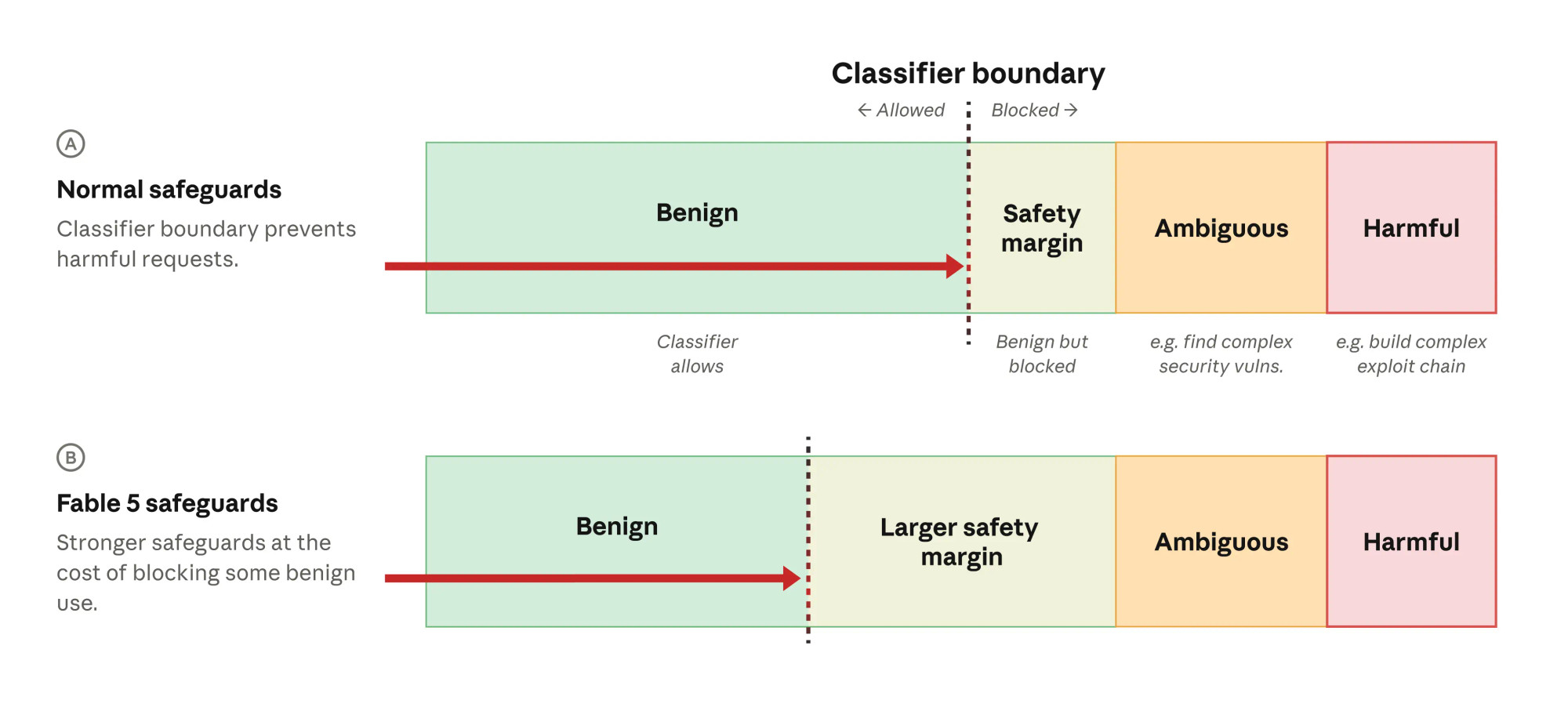
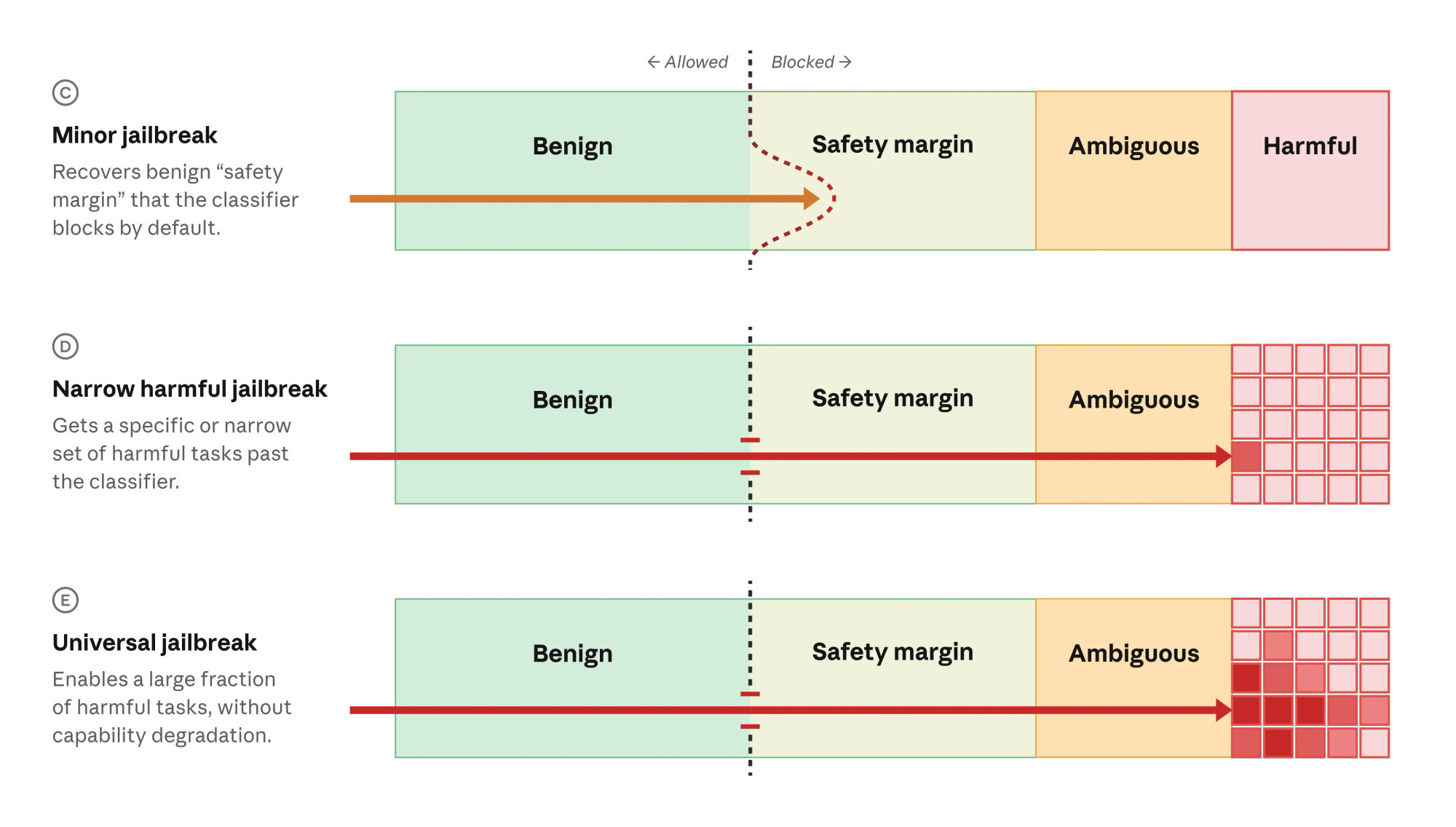
For Fable 5, a significantly larger "safety margin" was implemented, meaning the classifier blocks a greater number of requests that are probably benign but carry a small chance of being harmful. While sometimes frustrating for users, this ensures genuinely dangerous requests are blocked. Anthropic considers the "jailbreaks" reported so far for Fable 5 to fall into the "minor" category, not unlocking core harmful behaviors.
Recognizing the need for a unified standard, Anthropic is collaborating with Amazon, Microsoft, Google, and other Project Glasswing partners to develop a consensus framework for assessing the severity of AI jailbreaks. This framework proposes four criteria: capability gain, breadth of capability gain, ease of weaponization, and discoverability of the technique.
Additionally, Anthropic is deepening its collaboration with the US government, including the Department of Commerce's Center for AI Standards and Innovation (CAISI). This involves expanded early government access to models and safeguards for pre-release evaluation, rapid information sharing on jailbreaks, and dedicated resources for joint AI security research. Access to Mythos 5 was also restored for a set of US organizations on June 26, 2026, and access on AWS, Google Cloud, and Microsoft Foundry is expected to be re-enabled as quickly as possible.
The company hopes this cooperation and the industry framework will serve as the basis for systematic rules across the sector, and that these rules will be codified in strong, transparent regulation. To further enhance security, Anthropic will launch a new HackerOne program for security researchers to submit potential cyber jailbreaks discovered in Fable 5.
Article topics
Related articles

Mark Zuckerberg: AI Should Empower, Not Fully Automate Work
Meta's CEO warns against the risks of fully automating knowledge work with artificial intelligence, advocating for an approach that empowers employees and creates more jobs. His vision contrasts with other industry leaders amidst widespread AI-driven layoffs.

Schneider Electric acquires Cognite for $3.1 billion to boost industrial AI
French industrial giant Schneider Electric SE has agreed to buy Cognite, an industrial data and AI software firm, in a $3.1 billion transaction.

OpenAI Launches GPT-5.6 Series: Sol, Terra, and Luna with Enhanced Safety
OpenAI introduces a limited preview of its new GPT-5.6 models, showcasing significant advancements in coding, biology, and cybersecurity, alongside a reinforced safety framework and more accessible pricing for certain models.
Latest news
View all
Godox C100 Redefines Compact Photography with its Innovative Transparent Display
Godox launches the C100, an ultra-light 65-gram camera with an "avant-garde" design and an active transparent screen that prioritizes immersion in the moment.

Supergirl Faces Million-Dollar Losses After Challenging Box Office Debut
The DC film, starring Milly Alcock, grossed only $68 million on its opening weekend, with Warner Bros. projected to lose up to $120 million, according to reports.

AMD Zen 6 to Feature Low-Power Cores for Enhanced Efficiency
A discovery in the Linux kernel and an AMD engineer's confirmation reveal that upcoming Zen 6 processors will adopt a hybrid core strategy to optimize power consumption.
Comments (0)
No comments yet. Be the first!
Only registered readers can comment.