
SAP Predicts the End of the Keyboard: AI and Voice to Dominate Interaction in Two Years
SAP CEO Christian Klein anticipates a revolution in business data input, marking the decline of the traditional keyboard in favor of artificial intelligence and voice recognition.

The keyboard, a fundamental tool in computing since its inception, might be nearing its end. Christian Klein, CEO of software giant SAP, has declared that the era of typing for data entry into business systems is close to finishing, projecting this shift to occur within the next two to three years.
Klein highlights that voice recognition powered by large language models (LLMs) has achieved remarkable strength. The current challenge lies in translating this voice into business language and data that systems can comprehend. "The future will be, for sure, that you are not typing any data information into an SAP system. You can instead ask certain analytical questions with your voice. You can trigger operational task workflows. You can also make entries in the system with your voice—performance feedback, pipeline entries, et cetera. The technological capabilities are there, it really is now about the execution," Klein explained.
“The future will be, for sure, that you are not typing any data information into an SAP system. You can instead ask certain analytical questions with your voice.”
SAP, a company founded in 1972 and headquartered in Walldorf, Germany, is a global provider of cloud services to large corporations and SMEs. Klein, 44, is the youngest CEO of a major company listed on Germany's DAX index. He distinguishes between two approaches to AI adoption: those who see a profound change in their business and others who, despite investment, perceive limited value. The issue with the latter, according to Klein, is that they often implement AI as an isolated efficiency hack, without extending it to the rest of the organization.
For AI to truly transform a business, Klein emphasizes the importance of applying it horizontally, connecting different business areas. A concrete example is a large consumer goods company SAP is working with. By linking customer demand planning with financial planning and inventory control, they have managed to optimize inventory by 20%. "This is real money," Klein stated, highlighting the tangible impact of comprehensively applied AI.
AI execution goes beyond technology; it involves employee training. Klein envisions scenarios where an employee could ask an AI model to analyze millions of financial documents to identify the best measures for performance challenges. The outcome would be a detailed report with analysis and recommended actions, presented clearly and visually, allowing managers to adopt new ways of steering the company without requiring specific AI training, beyond the technology itself.
The discussion about the future of technology interaction took place at the World Economic Forum in Davos, a setting marked by increasing geopolitical tensions. Klein addressed how global fragmentation and growing data sovereignty demands impact companies operating internationally. "There are two superpowers in the world, and they’re using the power to have more influence. I don’t expect that this will change anytime soon," he commented.
This new reality requires businesses to adapt their operations. Klein explained that while software can help operate in over 100 countries, global fragmentation presents unique challenges. "You need the cloud server to be located in the country. In another country, you need to protect the data in a different way. In another country, you need to cut it from the global network. That can be pretty expensive," he noted.
“There are two superpowers in the world, and they’re using the power to have more influence. I don’t expect that this will change anytime soon.”
The need for local infrastructure and the ability to quickly reconfigure platforms in response to sanctions or export controls is crucial. Klein urged Europe to focus more on innovation and economic power, rather than solely on regulation, to influence the global stage. The era of applied AI demands business agility in an increasingly complex geopolitical landscape.
The history of human interaction with machines dates back to inventions like Henry Mill's in 1714, a precursor to the keyboard. Today, AI and voice are marking a new chapter, suggesting that the way we interact with technology is about to take a significant evolutionary leap.
Article topics
Related articles

Humanoid Robots Deployed in US Schools as Teacher Assistants
A pilot program in the Salamanca City Central school district will integrate Realbotix's M-Series robots and Optio AI assistant to enhance student engagement.
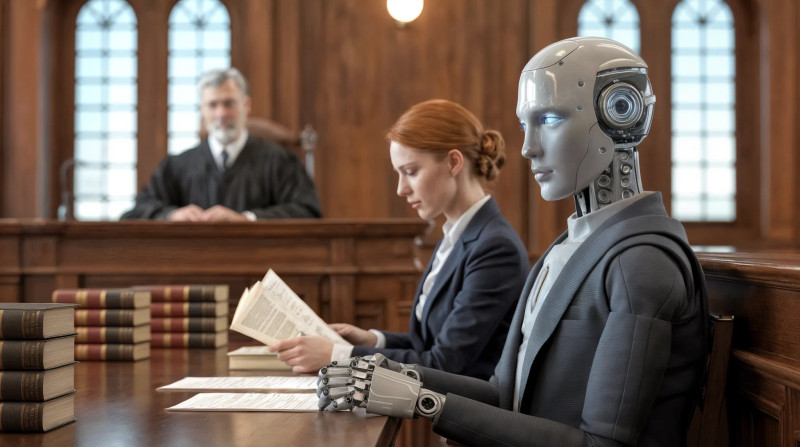
UK Law Firm Wins Case Using AI for Legal Documentation
A law firm in England achieved a landmark judicial victory by leveraging artificial intelligence to prepare all case documentation, setting a global precedent.

Meta Launches New Meta Glasses with AI and Real-time Translation
Meta's latest smart glasses, partly designed with Kylie Jenner, feature advanced AI that interprets surroundings and offers real-time translation.
Latest news
View all
Fallout TV Series Victor Figure to Launch in 2027
Fallout fans can look forward to a new collectible arriving in 2027: a detailed Victor figure, inspired by the popular Amazon TV series.

Science Protects Metabolism in Microgravity, but Muscles Remain a Challenge
A recent study reveals that metabolism and muscle deterioration do not always progress in tandem under weightless conditions, a key finding for astronauts and patients with reduced mobility.

Huawei Unveils LogicFolding 3D Chips Bypassing EUV Dependency
The Chinese tech giant introduced its LogicFolding architecture and Tau (τ) scaling law, aiming for 1.4 nm equivalent density by 2031 without ASML's EUV machines.
Comments (0)
No comments yet. Be the first!
Only registered readers can comment.