
The Hidden Sanctuary: A Revolutionary Discovery in the World of Seahorses
In a remote Bahamian lagoon, scientists have uncovered the largest known concentration of seahorses, offering unprecedented insights into their evolution and the health of marine ecosystems.

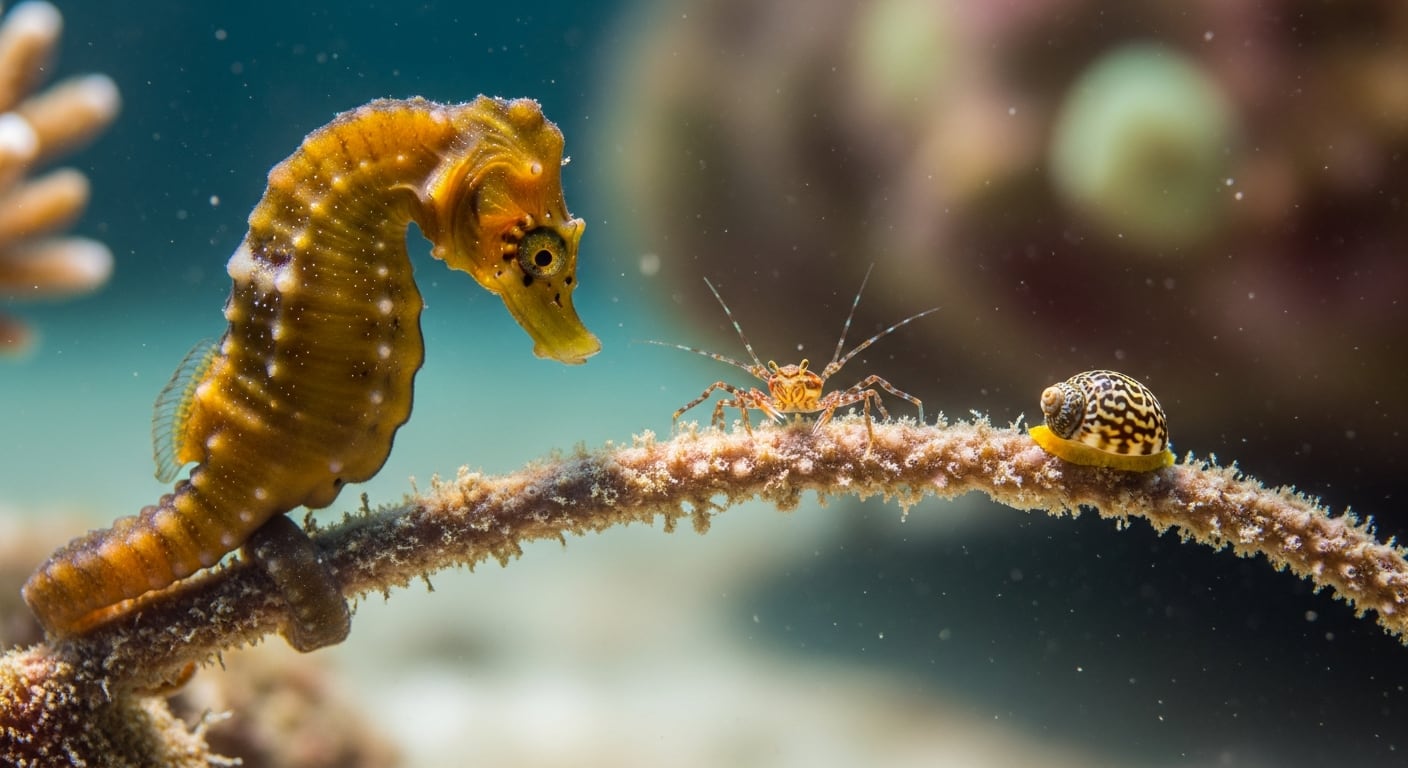
An unexpected scientific discovery in the pristine waters of the Bahamas is reshaping our understanding of seahorses and the dynamics of marine ecosystems. In Sweetings Lagoon, located on the island of Eleuthera, a research team has documented the largest known concentration of Atlantic striped seahorses (Hippocampus erectus). This finding is particularly remarkable, as scientists found more specimens in a single dive in Sweetings than in weeks of research across other vast areas of the Caribbean. The population is not only numerous but also exhibits distinct morphological characteristics, such as unusually long snouts and compact bodies, suggesting unique adaptive processes within this isolated environment.
This Bahamian enclave has rapidly become an invaluable natural laboratory for the scientific community. The presence of such a dense and peculiar seahorse population offers an unprecedented window into studying the health of marine ecosystems, the threats they face, and, crucially, how these rarely observed species evolve and adapt to their surroundings. Seahorses are recognized as sensitive indicators of environmental quality and the stability of coastal habitats. Their abundance and the specific traits of this Sweetings population allow for early identification of ecological imbalances and the design of more effective strategies for marine biodiversity protection. Heather Mason, a marine ecologist from the University of Tampa, who has dedicated decades to studying these creatures, emphasizes the magnitude of the finding: “In a single dive I counted more seahorse specimens than in weeks of research in other areas of the Caribbean,” a testament to how this discovery has shifted the scientific perspective on these elusive species.
Sweetings Lagoon is a biodiversity sanctuary with exceptional geographical and ecological characteristics. It is an isolated saltwater coastal enclave, cut off from the open sea, formed between seven and ten thousand years ago when it filled with filtered seawater from Hatchet Bay. Spanning 1.5 kilometers, this natural refuge provides vital protection for seahorses, shielding them from common open-ocean predators like sharks, tuna, and rays. In this relatively stable environment, which they share with seagrass beds, octopuses, and crabs, seahorses thrive in a way rarely observed elsewhere. Mason describes the location as “an island within an island,” an analogy that underscores the isolation and uniqueness of the habitat, allowing for the observation of behaviors and population dynamics different from those in more exposed environments, where external risks alter animal behavior. The enclosure's stability favors the persistence of large and differentiated populations, offering a unique opportunity to investigate the mechanisms of adaptation and natural selection under controlled conditions.
The research team, led by Mason and evolutionary biologist Emily Rose, has documented a population of Atlantic striped seahorses in Sweetings that exhibit longer-than-usual snouts, small bodies, and short tails. These distinct morphological characteristics have led researchers to propose a fascinating hypothesis: these specimens may be in the early stages of forming a subspecies, specifically adapted to the extreme isolation represented by the lagoon. This process of incipient speciation, driven by the selective pressures of such a particular habitat, offers novel clues about how evolution can operate over relatively short timescales and in geographically restricted environments. The study of this population not only enriches our knowledge of seahorse biology but also provides an exceptional model for understanding the fundamental principles of adaptation and species diversification in nature.
The implications of this discovery extend beyond the study of a single species. Sweetings Lagoon and its unique seahorse population underscore the critical importance of protecting these isolated biodiversity sanctuaries. By acting as bioindicators, the seahorses of Sweetings Lagoon offer an invaluable tool for monitoring the health of coastal ecosystems and anticipating the impacts of climate change and human activity. Continued research at this site promises to unveil even more secrets about the resilience of marine life and how we can safeguard these natural treasures for future generations. This discovery is not only a triumph for science but also a call to action for global marine conservation.
Keep reading online — scan the code
https://go.tricuatro.com/82ked
© tricuatro.com
Article topics
Related articles

Sweet Interstellar Discovery: Erythrulose Detected in the Milky Way
Scientists from the Spanish Astrobiology Center have for the first time identified a true sugar, erythrulose, in a gas and dust cloud near our galaxy's center. This finding suggests complex molecules can form before stars and planets are born.

SpaceX Scrubs Starship Test Flight in South Texas
Computer systems detected an anomaly during the Super Heavy booster's engine startup sequence, forcing the mission's abort.

JAXA's RV-X Reusable Rocket Successfully Completes First Flight
Japan's space agency JAXA successfully tested its RV-X prototype, a critical step towards reducing costs and boosting competitiveness in the global space market.
Latest news
View all
Paramount and Warner Bros. Merger Halted by Judge Over Antitrust Concerns
A coalition of 12 states successfully petitioned Judge Araceli Martinez-Olguin to temporarily block the deal, citing fears of higher prices and reduced content.

MIT Chip Converts Invisible Infrared Light into Crucial Data
MIT researchers developed an innovative chip detecting methane and propane using mid-infrared light, with potential for millions of pixels and optical computing.

Assassin's Creed Black Flag Resynced Smashes 3 Million Sales, New Game Plus Announced
Ubisoft's successful re-release of the pirate classic continues to break records, confirming one of the most requested features from the gaming community.
Comments (0)
No comments yet. Be the first!
Only registered readers can comment.