
Jupiter's Great Red Spot: New Study Unravels Centuries-Old Mystery
A groundbreaking study led by NASA Goddard scientists reveals new insights into the composition and enduring nature of Jupiter's iconic storm, first observed in 1665.
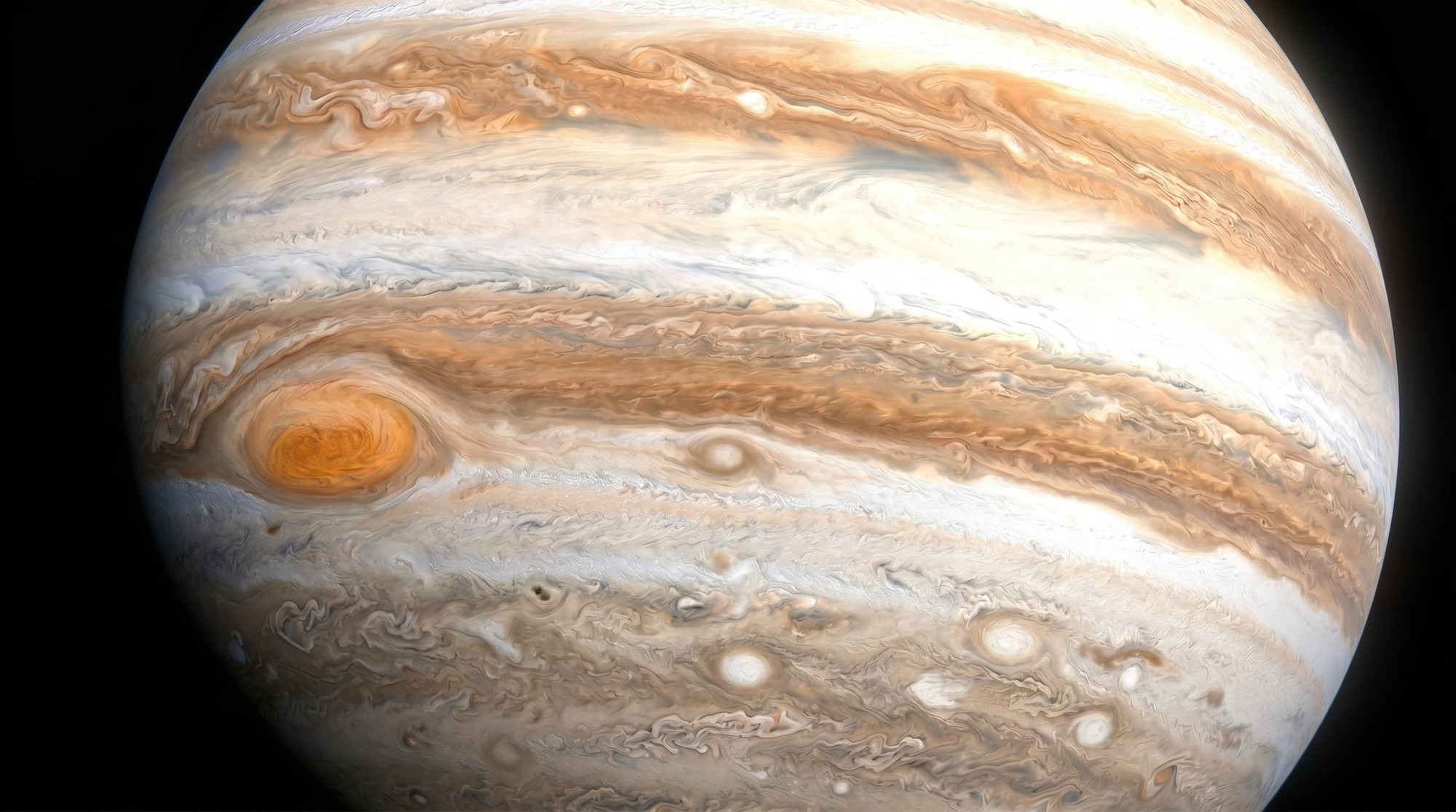
With nearly 190 years of continuous activity since its rediscovery in the 1830s, Jupiter's Great Red Spot remains one of the most fascinating and enigmatic atmospheric phenomena in our solar system. A new study, led by scientists from NASA's Goddard Center, promises to shed light on its deepest secrets, as reported by National Geographic.
This colossal vortex, first observed by Italian astronomer Gian Domenico Cassini in 1665, vanished from records for almost 160 years before powerfully re-emerging in the 1830s. Since then, it has been subject to uninterrupted systematic monitoring, establishing itself as the longest-lived and most enigmatic storm documented outside Earth.
Planetary atmospheres specialist Amy Simon, from NASA's Goddard Center, leads this crucial investigation, scheduled for publication in the prestigious journal Icarus. Simon emphasizes the immense difficulties in analyzing the storm's chemical composition, given the extreme and unique conditions present on Jupiter.
The persistence of the Great Red Spot, coupled with its longevity, makes it a natural laboratory for understanding the atmospheric mechanisms of gas giants. Simon's team's work allows for tracing the evolution of this colossal system over nearly 200 years, offering invaluable data for planetary research.
The persistence of the Great Red Spot, coupled with its longevity, makes it a natural laboratory for understanding the atmospheric mechanisms of gas giants.
In its earliest observations, the Great Red Spot exhibited an impressive diameter of between 40,000 and 50,000 kilometers, according to ancient records. At that time, this figure made it a structure capable of housing several Earths within its expanse, a scale that challenges our imagination.
Currently, the most recent measurements indicate that the vortex has undergone a reduction, now possessing an extent of 12,000 kilometers along its north-south axis and reaching 20,000 kilometers in an east-west direction. Despite this decrease, it can still accommodate two Earth-sized planets within it, demonstrating its enduring magnitude.
Systematic observations, such as those conducted by the Hubble Space Telescope, have confirmed that the dimensions of this system continue to fluctuate, indicating a constant evolution of the phenomenon. Jupiter's lack of a solid surface is a key factor in the storm's longevity and behavior, as the winds encounter insufficient friction to dissipate, allowing this structure to persist for centuries.
Unlike terrestrial weather systems, the Great Red Spot is a giant anticyclone that rotates counter-clockwise. While on Earth anticyclones are usually associated with fair weather, on Jupiter these systems generate extremely destructive winds and chaotic conditions, a fundamental difference in atmospheric dynamics.
This vortex remains confined between two jet streams circulating in opposite directions, which grants astonishing stability to its structure and prevents it from dissipating. It is this interaction of forces that allows it to maintain its shape and fury for such an extended period.
Inside the storm, winds reach astounding speeds of up to 680 km/h (423 mph), dragging clouds formed by ammonia ice, water, and a series of complex chemicals. This internal dynamic, coupled with an atmosphere composed primarily of hydrogen and helium, radically differentiates the Great Red Spot from any known meteorological phenomenon on our planet.
The study led by Amy Simon and her team also seeks to clarify the origin of the reddish hues that characterize the Great Red Spot. According to their research, colorless compounds like ammonium hydrosulfide, present in the deep layers of the Jovian atmosphere, could react to the impact of cosmic rays and ultraviolet radiation from the Sun.
Although this chemical reaction would affect only a small fraction of the atmosphere, it would be responsible for the observed coloration, a crucial detail for understanding its iconic appearance. However, Simon notes that precisely determining the exact process remains difficult due to the extreme environmental conditions, being five times farther from the Sun than Earth. Laboratory experiments attempting to replicate these circumstances have offered partial results, but a definitive explanation for the vortex's color palette is still elusive.
Article topics
Related articles

Jeff Bezos Proposes Space Data Centers and Relocating Earth Industries
The founder of Amazon and Blue Origin aims to alleviate terrestrial environmental pressure by moving intensive operations to space, seeing the Moon as a key first step.
NASA Orders ISS Crew to SpaceX Craft Amid Russian Segment Leak
Five astronauts took refuge in a Dragon capsule as Roscosmos considered a risky repair plan for an air leak in the Russian segment of the International Space Station.

Human Thought May Begin Before Birth, Study Suggests
Recent research from the University of Durham and Lisbon suggests that consciousness and thought form during gestation, challenging previous ideas.
Latest news
View all
iPhone Ultra: Apple's Foldable Emerges from iOS 27 Code
Apple's rumored iPhone Ultra, a high-cost foldable device, is beginning to take shape with revelations from iOS 27 code and developer directives at WWDC.

Arm Nears x86 in Server CPU Revenue in Q1 2026
The Arm architecture has captured nearly half of the data center processor market, driven by increasing artificial intelligence demand, marking a significant industry shift.

Google Discontinues Nest Mini and Nest Audio for Unified Home Ecosystem
Google is phasing out its popular Nest Mini and Nest Audio smart speakers to consolidate its product line under the Google Home brand, making way for a new Home Speaker.
Comments (0)
No comments yet. Be the first!
Leave a comment