
Harvard develops 3D printing for programmable artificial muscles
A Harvard team created an innovative technique enabling the production of soft, programmable muscles through rotational multimaterial 3D printing.
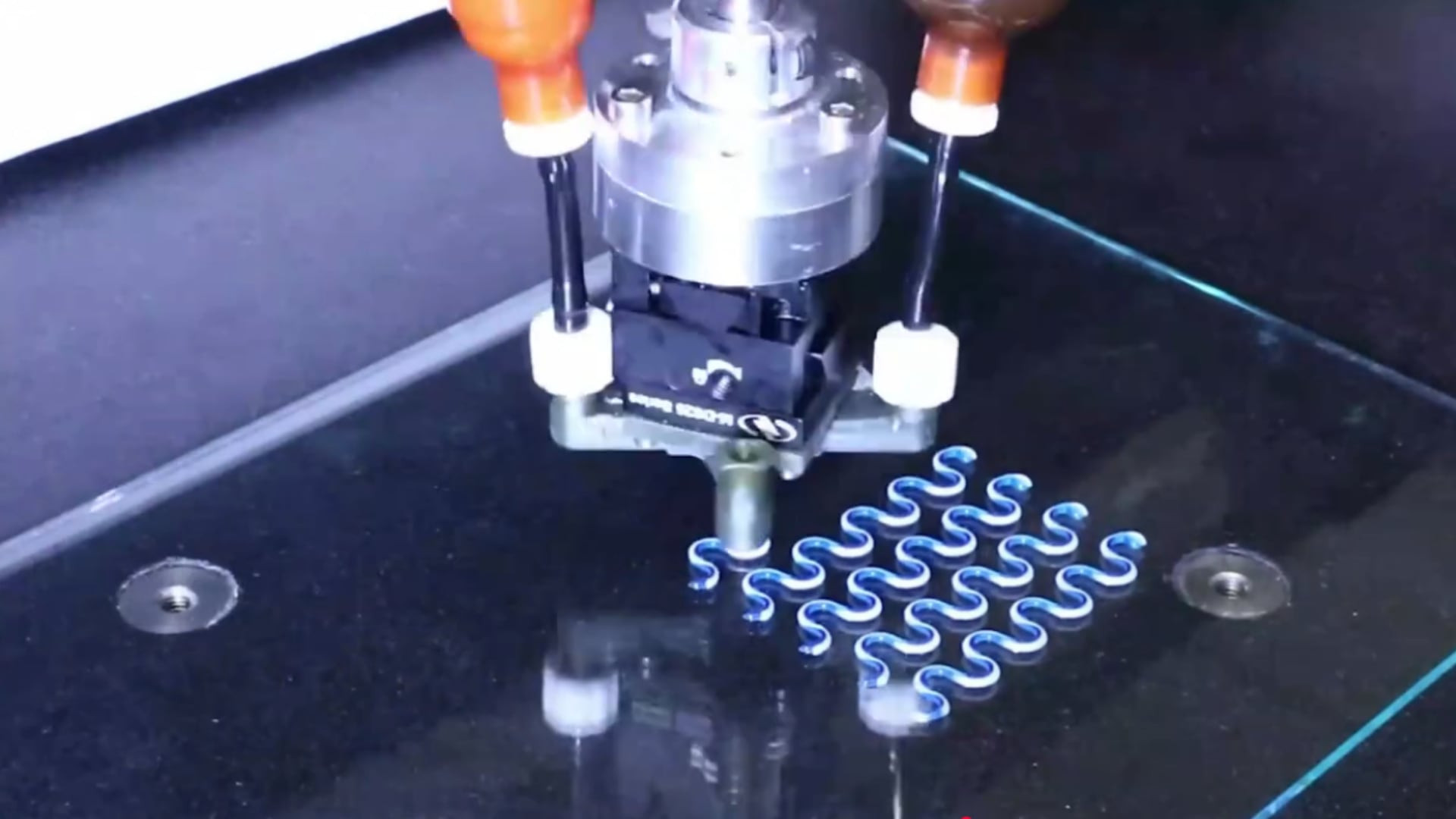
Researchers from Harvard's School of Engineering and Applied Sciences and the Wyss Institute have designed a groundbreaking 3D printing technique that mimics natural structures to create artificial muscles. Inspired by spiral forms found in nature, like vines and elephant trunks, they achieved that synthetic soft materials can perform complex movements such as bending, twisting, and contracting in response to heat stimuli.
The key innovation lies in the rotational multimaterial 3D printing method, which differs from traditional linear processes. Using a rotating nozzle, this technology extrudes and combines two types of materials: an active one, a liquid crystal elastomer (LCE), which contracts when heated, and a passive, soft elastomer that remains inert. The internal helicoidal structure formed during extrusion resembles biological tissues.
When heat is applied, the liquid crystal elastomer contracts, creating tension against the passive elastomer, resulting in predictable movements like bending or twisting without additional mechanical assembly. The rotation speed of the nozzle during printing controls the final shape of the filament once activated, allowing for customized responses tailored to specific needs.
This development opens new avenues in soft robotics and biomedical devices, as these helicoidal filaments can be used to build complex, functional structures like temperature-responsive filters or gripping tools. The programmable architecture transforms simple filaments into sophisticated devices capable of precise movements based on their internal design.
The study, published in PNAS, emphasizes how collaboration between mechanics and molecular alignment experts validated material behavior through advanced techniques such as X-ray scattering, showcasing its potential for robotics and medical applications.
Related articles

Elon Musk Plans Space Data Centers to Ease AI Energy Crisis
The escalating energy demand for artificial intelligence and terrestrial data centers is driving SpaceX to explore space-based solutions, with Starship being key to economic viability.

Windows 95 Runs on Texas Instruments Graphing Calculator
A modder successfully ported Windows 95 to a TI-Nspire CX II, showcasing modern calculator hardware capabilities.

Humanoid Robot Pemba Climbs Chimborazo, Sets Sights on Everest Summit
The humanoid robot Pemba, an adaptation of the Unitree G1, recently ascended over 6,000 meters on Chimborazo and now aims to conquer Mount Everest. This technological feat paves the way for new forms of exploration in extreme environments.
Latest news
View all
US Government Suspends Access to Anthropic's Fable 5 and Mythos 5 AI Models
A national security directive forces Anthropic to disable its advanced AI models, Fable 5 and Mythos 5, for all customers starting June 12, 2026.

Google Launches Gemini 3.5 Live Translate for Instant Voice Translation
Google expands real-time translation availability with Gemini 3.5 Live Translate, offering lower latency and support for over 70 languages.

SpaceX IPO Values Company at $1.77 Trillion on Nasdaq
SpaceX's anticipated public offering on the Nasdaq positions it as the seventh most valuable U.S. listed company, marking a significant financial milestone.
Comments (0)
No comments yet. Be the first!
Leave a comment