
AgiBot Humanoid Robots Complete 8-Hour Shift in Real Factory Setting
Four AgiBot humanoid robots successfully demonstrated their capabilities by working a full shift on a tablet assembly line. This breakthrough marks a significant step for AI integration in industry.
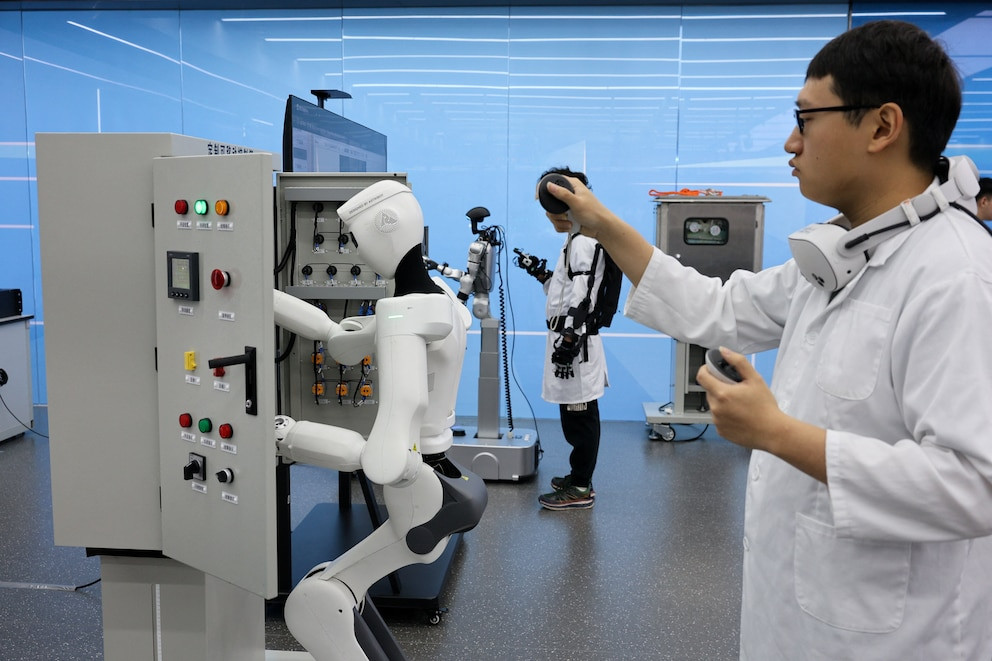
Four humanoid robots successfully completed an eight-hour shift on a real tablet assembly line. This significant demonstration marks a crucial milestone for integrating artificial intelligence into industrial processes. AgiBot led this groundbreaking test with its Genie G2 model, proving the viability of these machines in mass production environments.
During the shift, the robots operated on an active production line requiring fine movements and quick decisions. They performed quality inspection tasks with high levels of precision. Equipped with visual perception and force control systems, they identified, picked, and sorted components in real time. These actions replicate functions traditionally performed by human workers.
The Genie G2 model was central to this trial. This robot was capable of handling materials on a conveyor belt. It placed components into test boxes. It also separated defective products for manual review. Each operation was completed within cycles of 18 to 20 seconds.
One of the most relevant aspects of this advancement is the robots' ability to adapt to environmental changes without human intervention. The system can correct deviations of up to one centimeter. It responds to dynamic alterations on the production line. Furthermore, the robots calibrated their environment in just five minutes when facing different product models. This significantly reduces adjustment times, which in industrial contexts can take hours or even days.
In terms of performance, the Genie G2 achieved a processing capacity of up to 310 units per hour. Its accuracy rate exceeded 99.9%. These figures place it at levels comparable to human operators in specific precision tasks.
The robot has already accumulated over 140 hours of continuous operation in production environments, reinforcing its viability for industrial applications.
Unlike other technological demonstrations, this test took place on an active production line. It involved real working conditions, including product variations and constant operational rhythms. This deployment marks an important transition: humanoid robots are moving beyond laboratory prototypes. They are now integrating into concrete production processes. They can execute delicate operations requiring coordination and decision-making.
Following the results obtained, an expansion of these robots' use in larger-scale production lines is anticipated. AgiBot plans to deploy up to 100 units in the coming months. The goal is to integrate this technology into mass manufacturing processes. This will transform multiple industrial sectors!
Article topics
Related articles
Elon Musk Plans Space Data Centers to Ease AI Energy Crisis
The escalating energy demand for artificial intelligence and terrestrial data centers is driving SpaceX to explore space-based solutions, with Starship being key to economic viability.

Windows 95 Runs on Texas Instruments Graphing Calculator
A modder successfully ported Windows 95 to a TI-Nspire CX II, showcasing modern calculator hardware capabilities.

SpaceX IPO Values Company at $1.77 Trillion on Nasdaq
SpaceX's anticipated public offering on the Nasdaq positions it as the seventh most valuable U.S. listed company, marking a significant financial milestone.
Latest news
View all
US Government Suspends Access to Anthropic's Fable 5 and Mythos 5 AI Models
A national security directive forces Anthropic to disable its advanced AI models, Fable 5 and Mythos 5, for all customers starting June 12, 2026.

Google Launches Gemini 3.5 Live Translate for Instant Voice Translation
Google expands real-time translation availability with Gemini 3.5 Live Translate, offering lower latency and support for over 70 languages.

Humanoid Robot Pemba Climbs Chimborazo, Sets Sights on Everest Summit
The humanoid robot Pemba, an adaptation of the Unitree G1, recently ascended over 6,000 meters on Chimborazo and now aims to conquer Mount Everest. This technological feat paves the way for new forms of exploration in extreme environments.
Comments (0)
No comments yet. Be the first!
Leave a comment