
We Knew There Was Water on the Moon, But Not Why Some Craters Were Empty. Now We Have the Answer
Scientists from the University of Colorado Boulder explain why some permanently shadowed lunar craters lack ice, despite ideal conditions.
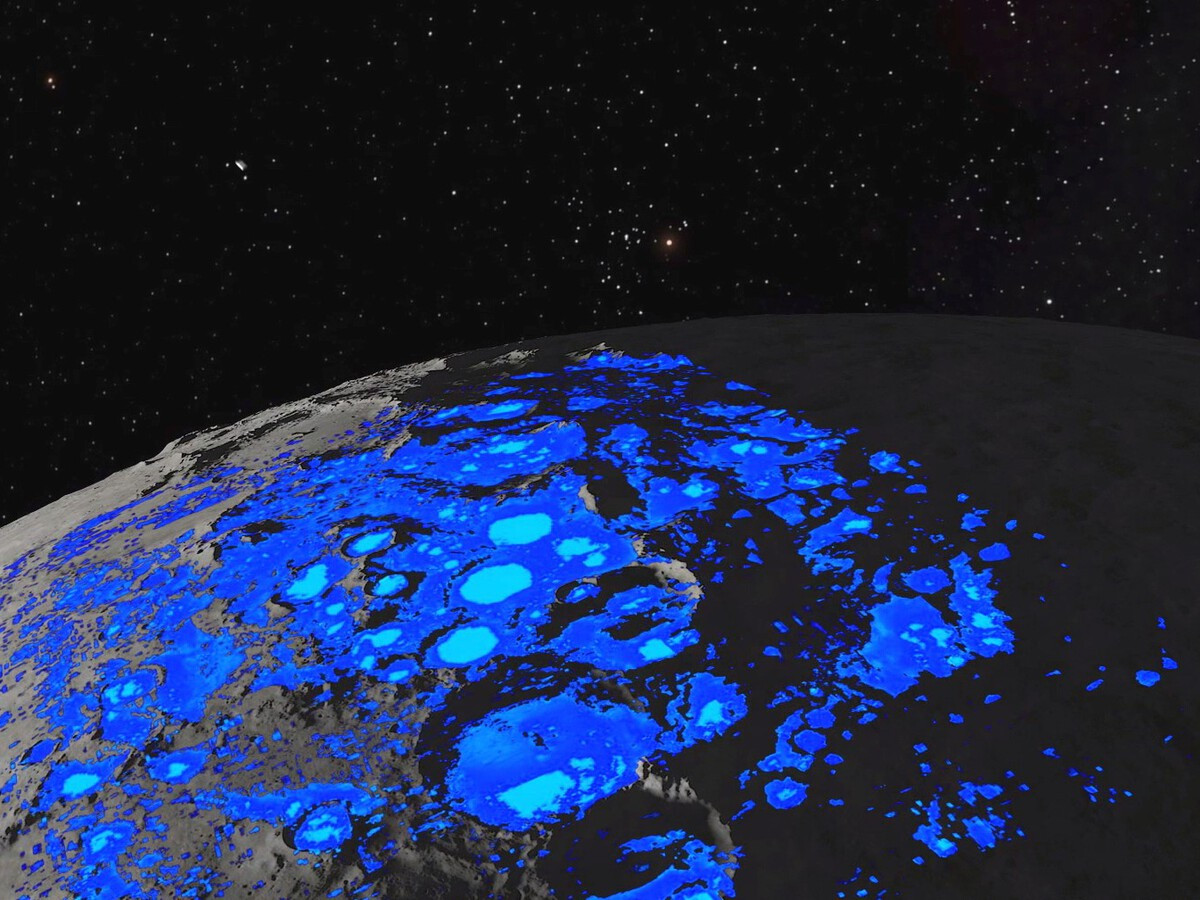
Water on the Moon: A Valuable Resource with Hidden Challenges
For decades, scientists have suspected the presence of water on the Moon, but it wasn’t until recent missions that its existence was confirmed—primarily in the form of ice. This discovery was a major milestone for future lunar exploration and potential colonization, as water is essential not only for human survival but also for producing oxygen and rocket fuel through processes like electrolysis. However, accessing this resource is far from straightforward. Water is not evenly distributed, and while ice has been detected in certain polar craters, many others with seemingly ideal conditions remain completely dry. This inconsistency puzzled researchers for years—until a new study provided a clear and detailed explanation.
Permanently Shadowed Regions: Cold Traps for Ice
Lunar ice has been primarily found in what are known as permanently shadowed regions (PSRs), deep inside craters near the Moon’s south pole. Due to the Moon’s low axial tilt, some of these craters never receive direct sunlight, allowing temperatures to remain below -200 °C. Under such extreme conditions, any water molecules—delivered by comet impacts, solar wind interactions, or surface chemistry—can become trapped and preserved indefinitely. These cold traps are therefore prime candidates for hosting ice deposits. Yet, surprisingly, not all shadowed craters contain water, raising a critical scientific question: why are some of them empty?
The Mystery of the Dry Craters
The absence of ice in certain craters that meet the necessary thermal conditions has long been a mystery. If temperatures are cold enough to preserve water, why isn’t it present everywhere? This is where a recent study led by scientists at the University of Colorado Boulder provides groundbreaking insight. By combining surface temperature data from NASA’s Lunar Reconnaissance Orbiter (LRO) Diviner instrument with advanced computer simulations of the Moon’s long-term rotational evolution, researchers discovered that the Moon’s orientation has shifted significantly over billions of years. This phenomenon, known as true polar wander, means the Moon’s rotational axis—and thus its poles—have not remained fixed in place throughout its history.
The Key Lies in a Crater’s Thermal History
A region that is a permanent cold trap today may not have been one in the distant past. Due to shifts in the Moon’s axis—driven by internal mass redistributions such as the formation of large volcanic basins—some areas now in permanent shadow may have been exposed to sunlight long ago. This means that while they are currently cold enough to retain ice, they never had the chance to accumulate it, as they were too warm in earlier epochs. In other words, the presence of water depends not only on current conditions but also on a crater’s long-term thermal history. Craters that have remained in shadow for billions of years are far more likely to harbor ice.
Implications for Future Lunar Exploration
This discovery has significant implications for upcoming lunar missions, especially those aiming for human settlement. Instead of focusing solely on current geography or surface temperature, mission planners and scientists must now consider the age and long-term thermal stability of potential landing sites. The study suggests that older craters at the lunar south pole are more likely to contain ice, making them top priorities for exploration. This deeper understanding will help optimize site selection and increase the chances of accessing one of the Moon’s most valuable resources: water.
Article topics
Related articles

NASA Reveals New Path for Earth's Essential Life Elements
A recent study, published in Science Advances, uncovers how early Earth may have received phosphorus and nitrogen, highlighting Jupiter's critical role.
NASA's Maven Mars Orbiter Declared Out of Service After Six Months of Silence
Following an anomaly that disrupted its orbit and depleted its batteries, the Maven spacecraft, vital for understanding Mars' atmosphere, has ended its active mission. Its scientific data remains an invaluable legacy.
NASA Space Robotics Challenge
NASA invites U.S. researchers to submit proposals for experiments using a robotic arm that will be sent to low Earth orbit as part of the Fly Foundational Robots mission.
Latest news
View all
Stuntman Hollywood: Returns After 19 Years to PS5, Xbox Series, and PC
The iconic action and vehicular stunt franchise makes its comeback courtesy of Saber Interactive, promising a dose of nostalgia and adrenaline for the new generation.

Windows Drops NTLM: Microsoft Boosts Security with Kerberos
Microsoft is taking a crucial step to bolster security in Windows 11, announcing the deprecation of NTLM, its oldest authentication protocol, in favor of Kerberos.

Google Launches Gemma 4 12B: Local AI for Your Laptop with 16GB RAM
Google's new artificial intelligence model aims to democratize access to generative AI, allowing it to run on average consumer computers.
Comments (0)
No comments yet. Be the first!
Leave a comment