
The Axolotl: The Amphibian That Regenerates Its Own Brain
This charismatic amphibian possesses an astonishing ability: the capacity to rebuild parts of its brain, an evolutionary mystery that fascinates scientists.
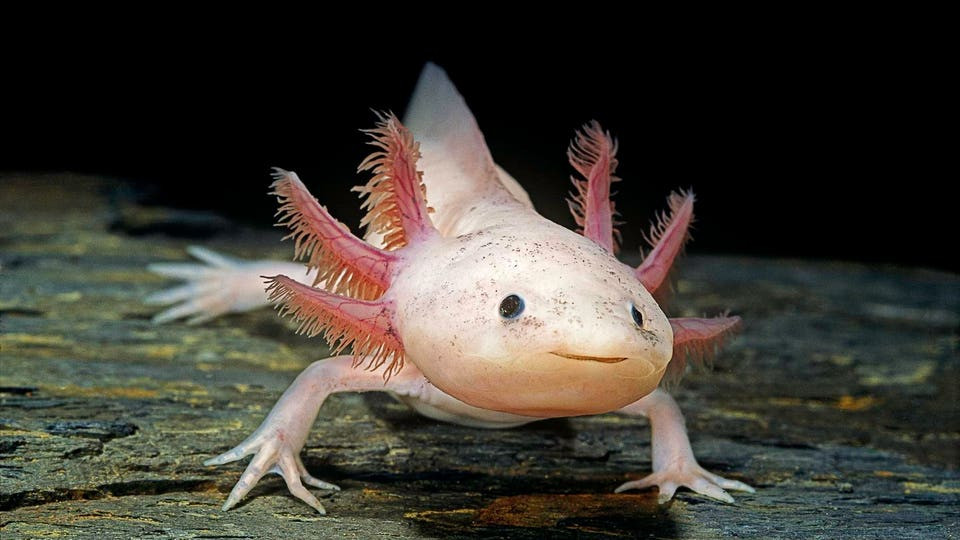
The axolotl (_Ambystoma mexicanum_), with its feathery pink gills and a permanent half-smile, looks almost too whimsical to be real. But don’t let its cartoonish exterior fool you. Beneath it lies one of the most extraordinary abilities in the animal kingdom: the power to rebuild parts of its own brain.
It doesn’t simply patch it over, nor does it merely heal around the damage. The axolotl can produce brand new neurons, restore damaged or lost structures, and reconnect circuits post-brain injury. For neuroscientists, this ability makes the axolotl a living paradox because the central nervous system is supposed to be fragile.
In stark contrast to mammals, where damage to the brain or spinal cord is typically irreversible due to mature neurons rarely regenerating and scar tissue forming quickly, the axolotl somehow sidesteps these limitations. Research reveals that its brain regeneration process is a highly coordinated sequence of events that resembles a replay of embryonic development.
When part of the axolotl’s telencephalon, the major region of the forebrain involved in sensory processing and behavior, is injured or removed, the first thing that happens is surprisingly mundane: the wound closes. Cells surrounding the damaged area seal the opening to stabilize the tissue. Crucially, though, this happens without the formation of any dense scar tissue typical of mammalian brains. This difference matters enormously.
In humans, glial scars form very quickly after injury. Although this helps contain damage, it also creates a biochemical barrier that effectively blocks any new neural growth. But axolotls largely avoid this response. Instead of walling off the injury, their brains remain permissive to rebuilding. After this, specialized cells lining the brain’s ventricles, called ependymoglial cells, are activated.
These cells function somewhat like dormant neural stem cells, and in a healthy brain, they’d remain dormant. After injury, however, they begin dividing rapidly, which marks the beginning of reconstruction. At this point, the newly produced cells migrate toward the injury site, where many begin transforming into immature neurons. Over weeks, these immature cells differentiate into the specific neuron types needed to replace what was lost.
The axolotl can produce brand new neurons, restore damaged or lost structures, and reconnect circuits post-brain injury.
What’s most fascinating about this step is that it isn’t random. Rather, the regenerating tissue appears to follow spatial and molecular instructions embedded within the surrounding brain. This means that the axolotl does not simply grow “more brain.” Somehow, it regrows the precise brain tissue needed, in the exact right location it’s needed in.
The reason behind this extraordinary capability stems from several factors. Compared to mammals, the axolotl brain is much less densely specialized and metabolically demanding. Many of its most essential behaviors, such as swimming and feeding, rely heavily on older, evolutionarily conserved neural circuits distributed throughout the brainstem and spinal cord. This means that damage to parts of the forebrain, although serious, won’t necessarily incapacitate the entire animal.
Furthermore, their relatively slow metabolism and aquatic, sedentary lifestyle make a lengthy repair process biologically feasible. Cellular plasticity is key: mature cells near damaged tissue can revert into a more flexible, developmental state, allowing for proliferation and the generation of new structures. This flexibility, while tightly restricted in mammals to prevent cancer or circuit disruption, is prioritized in the axolotl for regeneration.
The evolution of this extreme regenerative ability might not be a unique innovation but rather the retention of an ancestral trait. While mammals evolved towards faster wound sealing and stable neural systems, amphibians like the axolotl retained greater regenerative potential. Their ecology, vulnerable to predation and injury in aquatic environments, may have reinforced this ability, significantly improving reproductive success.
The axolotl’s neoteny, the phenomenon where they retain juvenile characteristics into adulthood, also plays a crucial role. Juvenile tissues in many vertebrates tend to be more regenerative than adult tissues, suggesting the axolotl preserves cellular programs that would otherwise be “switched off” after maturation. This regenerative capacity, which feels futuristic, might actually be an ancient biological inheritance that most mammals gradually abandoned.
Related articles

NASA Reveals New Path for Earth's Essential Life Elements
A recent study, published in Science Advances, uncovers how early Earth may have received phosphorus and nitrogen, highlighting Jupiter's critical role.

NASA's Maven Mars Orbiter Declared Out of Service After Six Months of Silence
Following an anomaly that disrupted its orbit and depleted its batteries, the Maven spacecraft, vital for understanding Mars' atmosphere, has ended its active mission. Its scientific data remains an invaluable legacy.
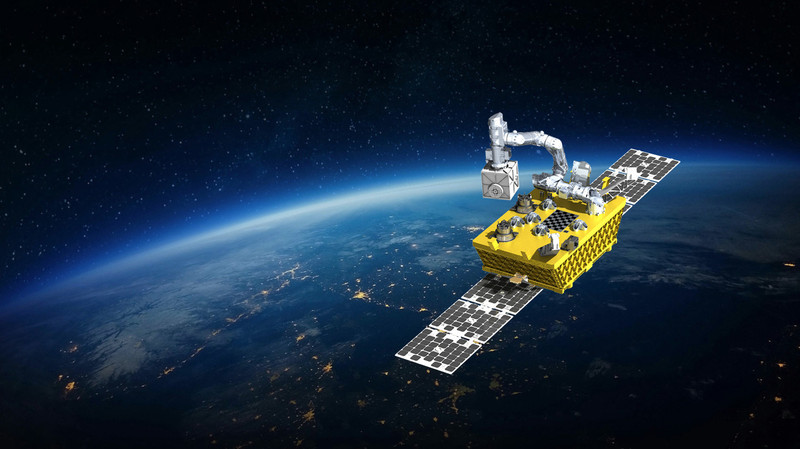
NASA Space Robotics Challenge
NASA invites U.S. researchers to submit proposals for experiments using a robotic arm that will be sent to low Earth orbit as part of the Fly Foundational Robots mission.
Latest news
View all
Stuntman Hollywood: Returns After 19 Years to PS5, Xbox Series, and PC
The iconic action and vehicular stunt franchise makes its comeback courtesy of Saber Interactive, promising a dose of nostalgia and adrenaline for the new generation.

Windows Drops NTLM: Microsoft Boosts Security with Kerberos
Microsoft is taking a crucial step to bolster security in Windows 11, announcing the deprecation of NTLM, its oldest authentication protocol, in favor of Kerberos.

Google Launches Gemma 4 12B: Local AI for Your Laptop with 16GB RAM
Google's new artificial intelligence model aims to democratize access to generative AI, allowing it to run on average consumer computers.
Comments (0)
No comments yet. Be the first!
Leave a comment