
Intel Texture Set Neural Compression: Intel's Answer to Revolutionize In-Game Texture Compression
Intel introduces TSNC, an innovative SDK leveraging neural compression to drastically reduce game texture sizes by up to 10x, offering a powerful alternative and enhancing the gaming experience.
Intel Texture Set Neural Compression: Intel's Answer to Revolutionize In-Game Texture Compression
In today's gaming landscape, where photorealistic graphics and high-resolution textures are the norm, efficient asset management has become a critical challenge. Game sizes are skyrocketing, loading times are increasing, and the demand for memory bandwidth and storage is becoming unsustainable. Faced with this scenario, the industry is actively seeking innovative solutions. NVIDIA has been exploring neural texture compression, and now, Intel responds with its own robust and concrete proposal: Intel Texture Set Neural Compression (TSNC). This initiative is not merely a laboratory demo but a Software Development Kit (SDK) designed for direct integration into game developers' workflows, promising a revolution in how textures are handled.
What is Intel Texture Set Neural Compression (TSNC)?
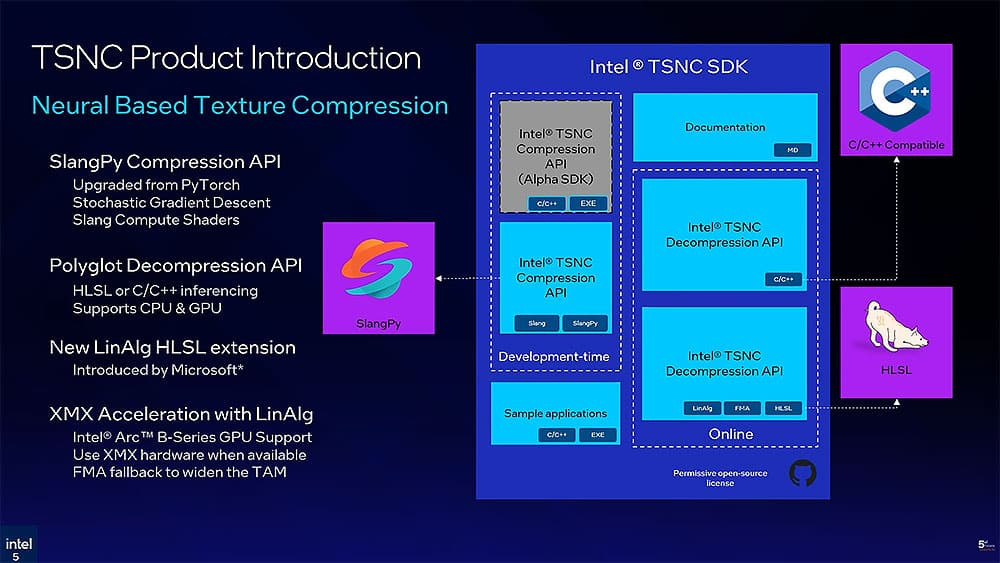
Intel Texture Set Neural Compression (TSNC) positions itself as a cutting-edge solution to address the problem of texture size. Essentially, TSNC is an SDK that enables aggressive reduction in the size of multiple texture maps. Its operation is based on a clever combination of techniques: it uses the BC1 compression format as its foundation, complements it with a compressed latent space, and crucially, employs a neural network to reconstruct texture data in real-time. The philosophy behind TSNC is clear and powerful: store less data in storage and memory, and dynamically reconstruct it when needed. This not only alleviates pressure on Solid State Drives (SSDs) and RAM but also optimizes bandwidth, allowing developers to create richer, more detailed worlds without compromising performance or user storage space.
Detailed Architecture and Functionality of TSNC
Intel's proposal with TSNC goes beyond a mere concept; it comes with a defined architecture and a clear roadmap. The process begins with a set of input textures that are processed by an encoder. This encoder generates two essential components: values in a latent space and the neural model's weights. Subsequently, a decoder, which is a three-layer Multi-Layer Perceptron (MLP) neural network, is responsible for recomposing the original texture channels. This MLP is designed with a 16-neuron input, a configurable hidden layer (16, 32, or 64 neurons, with 64 being the typical size for optimal balance), and a 16-neuron output. This entire system revolves around the BC1 format, which is already highly efficient, compressing to 0.5 bytes per pixel. With TSNC, a 4x4 texel block that would occupy 48 bytes uncompressed can be reduced to just 8 bytes, representing impressive compression. Furthermore, Intel has designed TSNC with an API intended for seamless integration into existing game engines and development tools, and it is expected to leverage the Matrix Extensions (XMX) of its GPUs to accelerate neural inference, ensuring optimal performance.
Compression Variants for Flexibility and Performance
Intel understands that compression is not a one-size-fits-all solution, and has therefore developed two main variants of its algorithm, referred to as “feature pyramid,” which allow for adjusting the balance between visual quality and compression ratio. Variant A uses two latent textures at 1:1 resolution and two others at 1:2 resolution. This configuration offers excellent quality with significant compression. On the other hand, Variant B is more aggressive, employing one texture at 1:1, another at 1:2, one at 1:4, and a final one at 1:8. This variant is designed for scenarios where maximum size reduction is a priority, albeit with a potential marginal impact on quality. To illustrate the impact, Intel provides a compelling example: a set of four 4096 x 4096 pixel textures, which uncompressed would occupy 256 MB (64.0 MB per texture), is drastically reduced. With Variant A, the total size drops to just 26.7 MB (10.7 MB, 10.7 MB, 2.7 MB, and 2.7 MB respectively). Variant B reduces it even further, to an astonishing 14.2 MB (10.7 MB, 2.7 MB, 0.68 MB, and 0.17 MB). In terms of compression ratio, while traditional BCx compression ranges between 4.79x and 4.80x, TSNC in its Variant A achieves between 9.53x and 9.59x, virtually doubling the efficiency of conventional methods.
Industry Impact and the Future of Gaming
The introduction of Intel Texture Set Neural Compression represents a significant step for the video game industry. For developers, an SDK with a well-defined API and a clear roadmap means a lower barrier to entry for implementing this technology. They will be able to create games with higher fidelity assets without excessive concern for the final game size or users' hardware limitations. For gamers, the benefits are direct and tangible: games with smaller downloads, reduced loading times, and a smoother gaming experience, as memory and bandwidth are freed up for other critical tasks. TSNC's ability to compress textures up to 10 times while maintaining comparable visual quality is a game-changer. This not only responds to competing solutions but also sets a new standard for graphic asset management, driving innovation and allowing virtual worlds to be even more immersive and accessible to everyone. Intel, with TSNC and the leveraging of XMX, reaffirms its commitment to advancing graphics technology within the gaming ecosystem.
Article topics
Related articles

Windows Drops NTLM: Microsoft Boosts Security with Kerberos
Microsoft is taking a crucial step to bolster security in Windows 11, announcing the deprecation of NTLM, its oldest authentication protocol, in favor of Kerberos.

Stuntman Hollywood: Returns After 19 Years to PS5, Xbox Series, and PC
The iconic action and vehicular stunt franchise makes its comeback courtesy of Saber Interactive, promising a dose of nostalgia and adrenaline for the new generation.

Tomb Raider: Legacy of Atlantis Arrives February 2027 with Pre-Order Bonuses
Crystal Dynamics and Amazon Games announce the release date for the reimagining of the 1996 classic, along with details on editions and exclusive pre-order content.
Latest news
View all
NASA's Maven Mars Orbiter Declared Out of Service After Six Months of Silence
Following an anomaly that disrupted its orbit and depleted its batteries, the Maven spacecraft, vital for understanding Mars' atmosphere, has ended its active mission. Its scientific data remains an invaluable legacy.

NASA Reveals New Path for Earth's Essential Life Elements
A recent study, published in Science Advances, uncovers how early Earth may have received phosphorus and nitrogen, highlighting Jupiter's critical role.

Google Launches Gemma 4 12B: Local AI for Your Laptop with 16GB RAM
Google's new artificial intelligence model aims to democratize access to generative AI, allowing it to run on average consumer computers.
Comments (0)
No comments yet. Be the first!
Leave a comment