
How Waldium Built a Blog Platform for Humans and AI Alike
Waldium, a YC-backed startup, has revolutionized content management with its agentic CMS, automating research and creation, and providing each blog with an MCP endpoint for direct AI interaction, all from a single Vercel deployment.
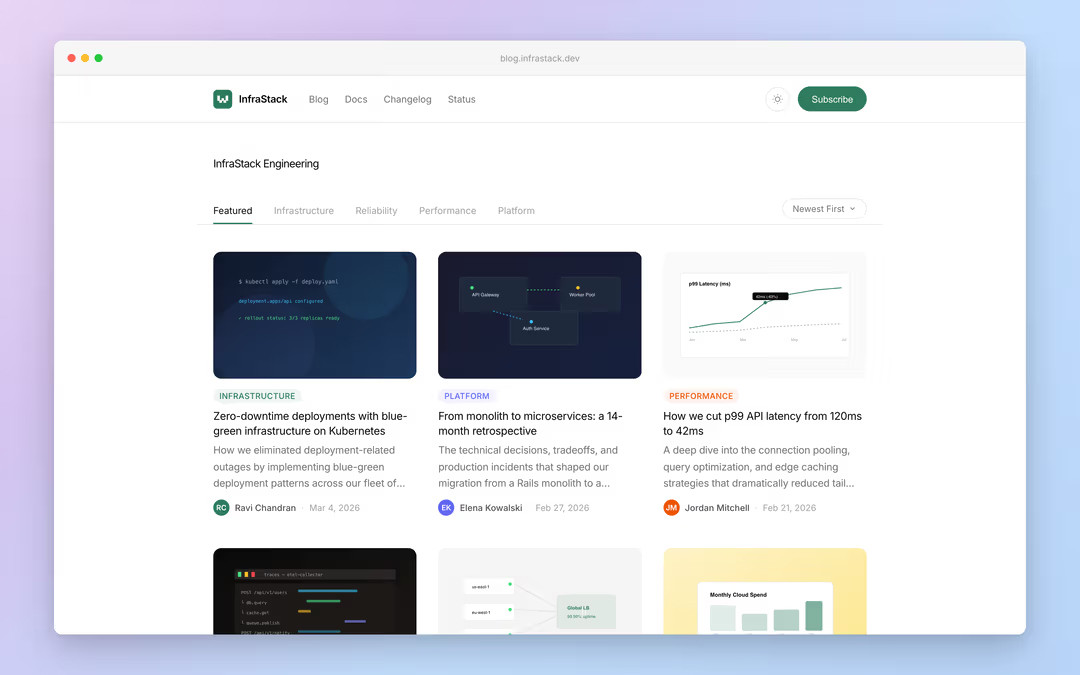
Waldium's Vision: An Agentic CMS for the AI Era
Waldium, a promising Y Combinator-backed startup co-founded by Amrutha Gujjar (CEO) and Shivam Singhal (CTO), is redefining the landscape of enterprise content management. Their innovative platform, an agentic CMS, not only automates content research and creation but also sets a new standard by providing every customer blog with its own MCP (Model Context Protocol) server endpoint. This unique feature allows AI agents to directly query and interact with content, marking a significant leap in how businesses can leverage their digital assets. Remarkably, this entire sophisticated infrastructure operates from a single Next.js deployment on Vercel, showcasing impressive efficiency and scalability from its inception.
Overcoming Infrastructure Friction
The genesis of Waldium lies in a common frustration within software development. Amrutha Gujjar, with years of experience building systems, often found herself bogged down not by the creative or exciting parts of her work, but by the obstacles presented by underlying infrastructure. "I was never stuck on the part I was excited to build," Amrutha recalls. "It was always the infrastructure friction around it." This experience became a fundamental design principle for Waldium: the infrastructure needed to disappear, allowing the product to remain focused on its core value proposition and what made it truly interesting. This minimalist, product-centric approach is key to their success.
When AI Agents Joined the Audience
Initially, Waldium, like most content platforms, focused on building blogs for human readers. However, Amrutha began to notice a subtle yet significant shift in who, and what, was accessing that content. Developers and technical teams were pulling blog content directly into their coding environments, into tools like Claude Desktop or ChatGPT, using it as live context within their actual workflows. The browser tab was still part of the picture, but it was no longer the whole story. Content that couldn't travel into these new environments was leaving reach and utility on the table.
This insight pointed Waldium toward adopting the Model Context Protocol (MCP) as a crucial primitive. The idea was simple yet powerful: if every customer blog had its own MCP server endpoint, an AI assistant could search, retrieve, and interact with that content directly, without anyone leaving their workflow. This means a developer could ask an agent to find a specific code snippet across an entire blog archive and get an answer in the same window where they were building. For technical founders who don't necessarily see themselves as marketers, this opened up an entirely new dimension. "Being able to use MCP," Amrutha explains, "allows you to create a blog post from the same place you're building a feature."
Scaling with Efficiency: The Vercel Choice
Supporting hundreds of customer blogs across custom domains is already a serious engineering challenge. But Waldium's vision went further: equipping each of those blogs with its own branded MCP server, complete with subdomain generation, SSL certificates, and a live install page. Quickly, the "do-it-yourself" approach became unsustainable. Waldium had started by assembling their own pipeline on AWS Amplify, wiring GitHub Actions, managing deployment configs, and handling SSL manually. As the number of tenants grew, the complexity grew even faster, and the team found themselves spending more time maintaining infrastructure than building their core product. The need for a more robust and scalable solution was evident.
It was then that Waldium moved to Vercel, a decision that transformed their operational capabilities. Vercel's platform allowed them to consolidate their entire infrastructure, serving over 500 customer blogs from a single deployment. New customers get their MCP endpoints live in under 5 minutes, and AI query response times consistently remain below 50ms globally. Furthermore, this consolidation resulted in a 45% lower infrastructure cost compared to a per-customer deployment model. These benefits aren't just technical; one customer, for instance, generated over 1,000 posts in a single month, cutting research time from weeks to mere hours, demonstrating the direct impact on content productivity and efficiency.
The Future of AI-Powered Content
Waldium's story is a testament to the power of user-centric innovation and strategic infrastructure choices. By eliminating infrastructure friction and embracing the growing importance of AI agents as content consumers, Waldium has built a platform that is not only efficient and scalable but also future-proof. Their approach allows businesses to focus on what they do best: creating valuable content, while the technology ensures that content reaches its audience, whether human or artificial intelligence, in the most effective way possible. Waldium isn't just building blogs; it's building the bridge to the next generation of content interaction.
Related articles
Google Launches Gemma 4 12B: Local AI for Your Laptop with 16GB RAM
Google's new artificial intelligence model aims to democratize access to generative AI, allowing it to run on average consumer computers.

Nvidia Challenges Intel and AMD with RTX Spark Superchip for PCs
Nvidia introduced RTX Spark, a processor promising to bring advanced artificial intelligence directly to your PC, without cloud dependence, and boost gaming to unprecedented levels on conventional machines.

Anthropic's Claude Opus 4.8 boosts "honesty" and reduces code flaws
Anthropic's new AI model, Claude Opus 4.8, launches this Thursday with a focus on transparency and error reduction, giving users more control over computational effort.
Latest news
View all
Stuntman Hollywood: Returns After 19 Years to PS5, Xbox Series, and PC
The iconic action and vehicular stunt franchise makes its comeback courtesy of Saber Interactive, promising a dose of nostalgia and adrenaline for the new generation.

NASA's Maven Mars Orbiter Declared Out of Service After Six Months of Silence
Following an anomaly that disrupted its orbit and depleted its batteries, the Maven spacecraft, vital for understanding Mars' atmosphere, has ended its active mission. Its scientific data remains an invaluable legacy.

Windows Drops NTLM: Microsoft Boosts Security with Kerberos
Microsoft is taking a crucial step to bolster security in Windows 11, announcing the deprecation of NTLM, its oldest authentication protocol, in favor of Kerberos.