
Fossil Footprint and Magnetic Fields: New Study Reveals Why Gas Giants Spin Faster Than More Massive Brown Dwarfs
A groundbreaking study, utilizing data from the W.M. Keck Observatory, has discovered that gas giant exoplanets rotate faster than more massive brown dwarfs, challenging previous notions about the relationship between mass and rotation and highlighting the crucial role of magnetic fields in their formation.
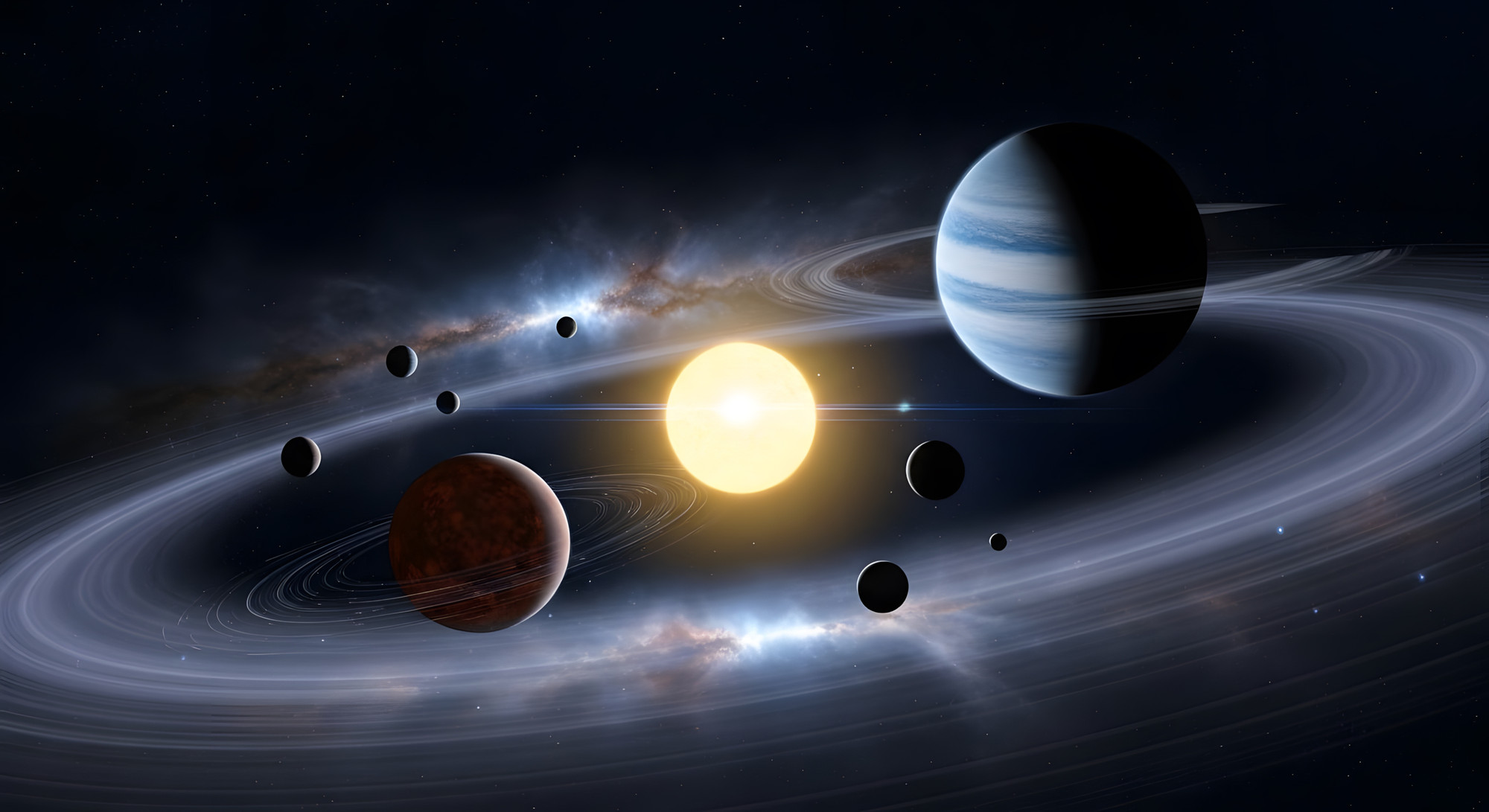
The exploration of exoplanets has profoundly transformed our understanding of the universe, unveiling a diversity of worlds that defy expectations. In this context, a recent and comprehensive study has shed light on a fundamental aspect of these celestial bodies: their rotation speed. This work, the largest ever conducted on exoplanet rotation rates, has revealed a surprising finding: gas giant planets, despite being less massive, spin faster than more massive brown dwarfs. This discovery not only prompts a re-evaluation of how the physical environment impacts the history of distant worlds but also underscores the importance of planetary mass, the planet-to-star mass ratio, and the complex effects of magnetic fields during the initial stages of formation as key determinants of these bodies' final rotation speeds.
An Unprecedented Study in Exoplanet Astronomy
Published on April 5, 2026, in the prestigious scientific journal The Astronomical Journal, this study is based on meticulous data collected at the W.M. Keck Observatory, located atop Maunakea, Hawaii. The research team, coordinated by the Center for Interdisciplinary Exploration and Research in Astrophysics (CIERA) at Northwestern University, collaborated with world-renowned institutions such as Caltech, the University of California San Diego, and the NASA Jet Propulsion Laboratory. The scale of this research is remarkable: scientists directly observed 32 gas giant planets and brown dwarfs orbiting distant stars. This information was combined with data from previous studies, allowing for the analysis of a total of 43 gas giant planets and brown dwarfs, and an even broader sample of 54 brown dwarfs and rogue planetary objects. This comprehensive approach has provided a robust database for unraveling the mysteries of exoplanetary rotation.
Rotation as a “Fossil Footprint” of Planetary Formation
The study's lead author, Dino Chih-Chun Hsu, a member of CIERA, emphasized the significance of rotation in an interview with Universe Today: “Rotation is a fossil footprint of how a planet formed. By measuring how fast these worlds spin, it’s possible to reconstruct the physical processes that shaped them tens or hundreds of millions of years ago.” This analogy is key to understanding the scope of the discovery. An exoplanet's rotation speed is not an isolated piece of data but an intrinsic record of its evolutionary history. The factors influencing this “fossil footprint” include the exoplanet's mass, its proportion relative to its host star's mass, and, crucially, the influence of magnetic fields during its early formation stages. The study's sample, which includes planets located tens or hundreds of astronomical units from their stars, allowed for the observation of a significant diversity of conditions, offering a unique window into the complexity of planetary formation.
Magnetic Fields: The Invisible Brake in Formation
One of the study's most revealing findings centers on the role of magnetic fields. To illustrate their impact, the HR 8799 system serves as a representative case. In this system, a gas giant planet with a mass seven times that of Jupiter spins six times faster than a brown dwarf, which possesses a mass 24 times that of Jupiter, coexisting within the same system. This marked difference in rotation speed, despite the brown dwarf's greater mass, was attributed by Hsu to a more intense interaction of the more massive object's magnetic field with its circumplanetary disk during its initial stage. This magnetic interaction acted as a “brake,” significantly slowing its rotation. This mechanism suggests that magnetic fields can dissipate angular momentum more efficiently in more massive objects, counteracting the expectation that greater mass should, in principle, lead to faster rotation due due to angular momentum conservation.
Implications for Formation and Angular Momentum Distribution
These results reinforce the idea that both the planet's intrinsic mass and its proportion relative to its star's mass are fundamental factors influencing the final rotation of these objects. The study not only confirms the complexity of planetary formation processes but also outlines key mechanisms in the distribution of angular momentum within protoplanetary systems. The interaction between the forming object and its surrounding disk, mediated by magnetic fields, emerges as a dynamic and crucial process. Understanding how angular momentum is distributed is essential for accurately modeling the evolution of planetary systems, from the formation of inner rocky planets to that of gas giants and brown dwarfs in the outermost regions.
Technological Advancements: The Key to Unlocking Cosmic Secrets
The progress achieved in this study would not have been possible without significant advancements in astronomical observation technologies. High-resolution spectroscopy, a technique that allows for the analysis of light from distant objects with unprecedented detail, was fundamental for precisely measuring the rotation speeds of these exoplanets and brown dwarfs. Instruments like those at the W.M. Keck Observatory are pioneers in this capability, enabling astronomers to discern subtle changes in the light spectrum that reveal the speed at which an object rotates. These tools not only open new avenues for exoplanet research but also demonstrate how technological innovation is indispensable for unraveling the deepest secrets of the universe, allowing us to reconstruct the history and physics of worlds light-years away.
Article topics
Related articles
NASA Reveals New Path for Earth's Essential Life Elements
A recent study, published in Science Advances, uncovers how early Earth may have received phosphorus and nitrogen, highlighting Jupiter's critical role.
NASA's Maven Mars Orbiter Declared Out of Service After Six Months of Silence
Following an anomaly that disrupted its orbit and depleted its batteries, the Maven spacecraft, vital for understanding Mars' atmosphere, has ended its active mission. Its scientific data remains an invaluable legacy.

NASA Space Robotics Challenge
NASA invites U.S. researchers to submit proposals for experiments using a robotic arm that will be sent to low Earth orbit as part of the Fly Foundational Robots mission.
Latest news
View all
Stuntman Hollywood: Returns After 19 Years to PS5, Xbox Series, and PC
The iconic action and vehicular stunt franchise makes its comeback courtesy of Saber Interactive, promising a dose of nostalgia and adrenaline for the new generation.

Windows Drops NTLM: Microsoft Boosts Security with Kerberos
Microsoft is taking a crucial step to bolster security in Windows 11, announcing the deprecation of NTLM, its oldest authentication protocol, in favor of Kerberos.

Google Launches Gemma 4 12B: Local AI for Your Laptop with 16GB RAM
Google's new artificial intelligence model aims to democratize access to generative AI, allowing it to run on average consumer computers.
Comments (0)
No comments yet. Be the first!
Leave a comment