
NASA Reveals Stunning Details of Meteor That Shook the United States
The space agency has shared new information about the fireball that released energy equivalent to 230 tons of TNT, shaking a vast region.
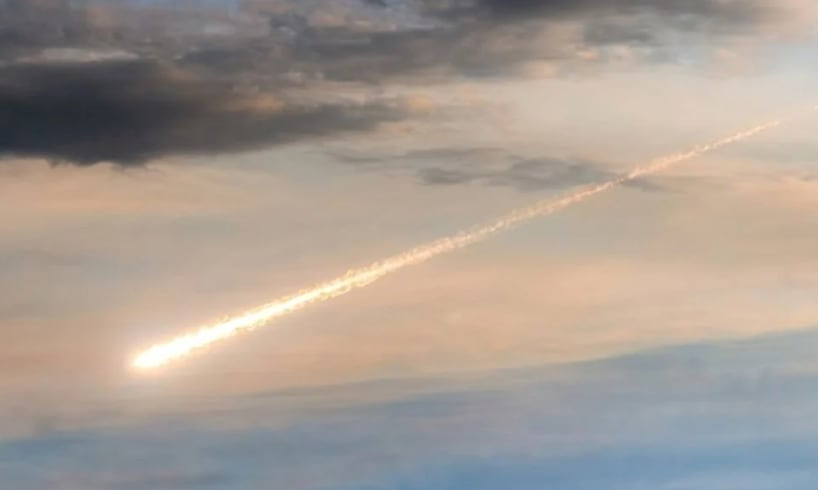
NASA has unveiled unprecedented details about the meteor that recently flew over the United States, confirming it released energy equivalent to 230 tons of TNT. This powerful blast rattled buildings and triggered alarms across an area stretching from Massachusetts to Maine and from Delaware to Montreal, Canada.
The magnitude of this atmospheric explosion far exceeded initial estimates, startling thousands of residents. The object did not become a meteorite because it disintegrated completely at high altitude, but its passage left an unmistakable sonic and vibrational footprint across the region.
According to the technical reconstruction released by NASA, the meteor was approximately 1.52 meters wide and had a mass comparable to that of an elephant, up to seven tons. It traveled at an astonishing speed of 67,600 kilometers per hour through the atmosphere, covering a trajectory of 41.8 kilometers before its disintegration, generating a double boom.
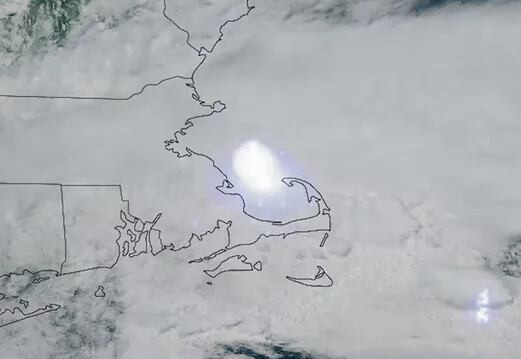
The immediate hours following the event were marked by a wave of questions on social media. Residents across Massachusetts, Rhode Island, and New Hampshire queried online if others had felt or heard the loud boom. Many witnesses reported that dogs reacted nervously, and some people initially thought it was an earthquake or a tree falling on their homes.
The widespread confusion even reached official institutions. The U.S. Geological Survey (USGS) received hundreds of reports through its “Did You Feel It?” system, typically designed for perceived seismic movements. However, seismographs detected no tectonic activity, confirming the vibrations originated from the meteor's atmospheric explosion rather than an earthquake.
The American Meteor Society also received dozens of reports from a wide region, extending from Delaware to Montreal. Some witnesses described seeing a brilliant fireball streaking across the sky before it disintegrated. Notably, a resident of Peabody, Massachusetts, recounted initially believing a large tree had fallen on their house.
NASA experts explained that the phenomenon is what astronomers call a “fireball,” an exceptionally bright meteor. Upon entering the atmosphere at extreme velocities, friction with the air dramatically raises the material's temperature, causing it to fragment and, in some cases, produce atmospheric explosions known as “airbursts.”
The material began to fragment and, in this case, produced an atmospheric explosion capable of generating shockwaves comparable to small explosive events.
The sheer energy released by the meteor was one of the data points that most surprised both scientists and the public. The official report confirmed the meteor was composed of natural material, ruling out space debris. The explosion occurred at high altitude, with fragments falling into Cape Cod Bay in southeastern Massachusetts.
Fireballs hold a central place in astronomy due to their potential to generate high-energy atmospheric explosions. This particular explosion's intensity meant its sound was perceived across four states and parts of Canada over 300 kilometers from the entry point.
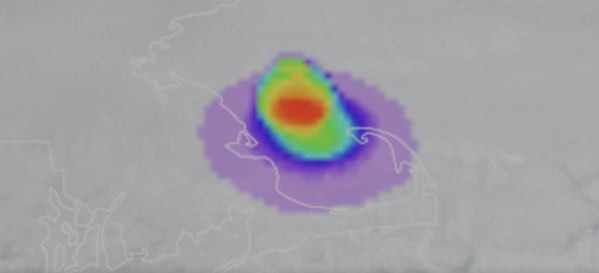
This episode also tested the effectiveness of citizen alert and reporting systems. Hundreds of people turned to official platforms and social media to share their experiences, with reports emerging in Massachusetts and Rhode Island and extending to localities in northeastern New England, New Hampshire, and even Maine, whose capital is 400 kilometers from Massachusetts, as highlighted by NASA in its report.
The case of the meteor that shook the northeastern United States offers an opportunity to understand how space object surveillance works. NASA and other international agencies maintain monitoring systems capable of detecting and analyzing space rock entries into the atmosphere, assessing both potential risks and the frequency of these occurrences.
Meteors can enter Earth's atmosphere at any time, but only on rare occasions do they produce explosions intense enough to be widely perceived by the population. Most disintegrate harmlessly at high altitudes. When the mass, velocity, and entry angle align, the result can be a visible fireball and an audible boom over long distances, with the released energy directly proportional to the object's mass and speed.
NASA advises maintaining calm during such events and trusting available monitoring and alert systems. Scientists emphasize that meteor impacts in inhabited areas are infrequent. Security and surveillance protocols are continuously updated, and information is quickly disseminated to prevent the spread of rumors or erroneous interpretations.
“This was a daylight bolide that produced meteorites falling right in the middle of Cape Cod Bay,” NASA specified in its latest report. The event showcased the value of clear scientific communication and the importance of public education in addressing the confusion that unforeseen astronomical phenomena can generate.
Article topics
Related articles
NASA Reveals New Path for Earth's Essential Life Elements
A recent study, published in Science Advances, uncovers how early Earth may have received phosphorus and nitrogen, highlighting Jupiter's critical role.
NASA's Maven Mars Orbiter Declared Out of Service After Six Months of Silence
Following an anomaly that disrupted its orbit and depleted its batteries, the Maven spacecraft, vital for understanding Mars' atmosphere, has ended its active mission. Its scientific data remains an invaluable legacy.
NASA Space Robotics Challenge
NASA invites U.S. researchers to submit proposals for experiments using a robotic arm that will be sent to low Earth orbit as part of the Fly Foundational Robots mission.
Latest news
View all
Stuntman Hollywood: Returns After 19 Years to PS5, Xbox Series, and PC
The iconic action and vehicular stunt franchise makes its comeback courtesy of Saber Interactive, promising a dose of nostalgia and adrenaline for the new generation.

Windows Drops NTLM: Microsoft Boosts Security with Kerberos
Microsoft is taking a crucial step to bolster security in Windows 11, announcing the deprecation of NTLM, its oldest authentication protocol, in favor of Kerberos.

Google Launches Gemma 4 12B: Local AI for Your Laptop with 16GB RAM
Google's new artificial intelligence model aims to democratize access to generative AI, allowing it to run on average consumer computers.
Comments (0)
No comments yet. Be the first!
Leave a comment