
NASA Confirms Ancient Lake Sediments on Mars, Key to Life Search
The Perseverance rover discovered evidence of a lake over 3.5 billion years old in Jezero Crater, Mars, containing clay minerals that could preserve signs of ancient life. This finding is crucial for the mission to seek biosignatures on the Red Planet.
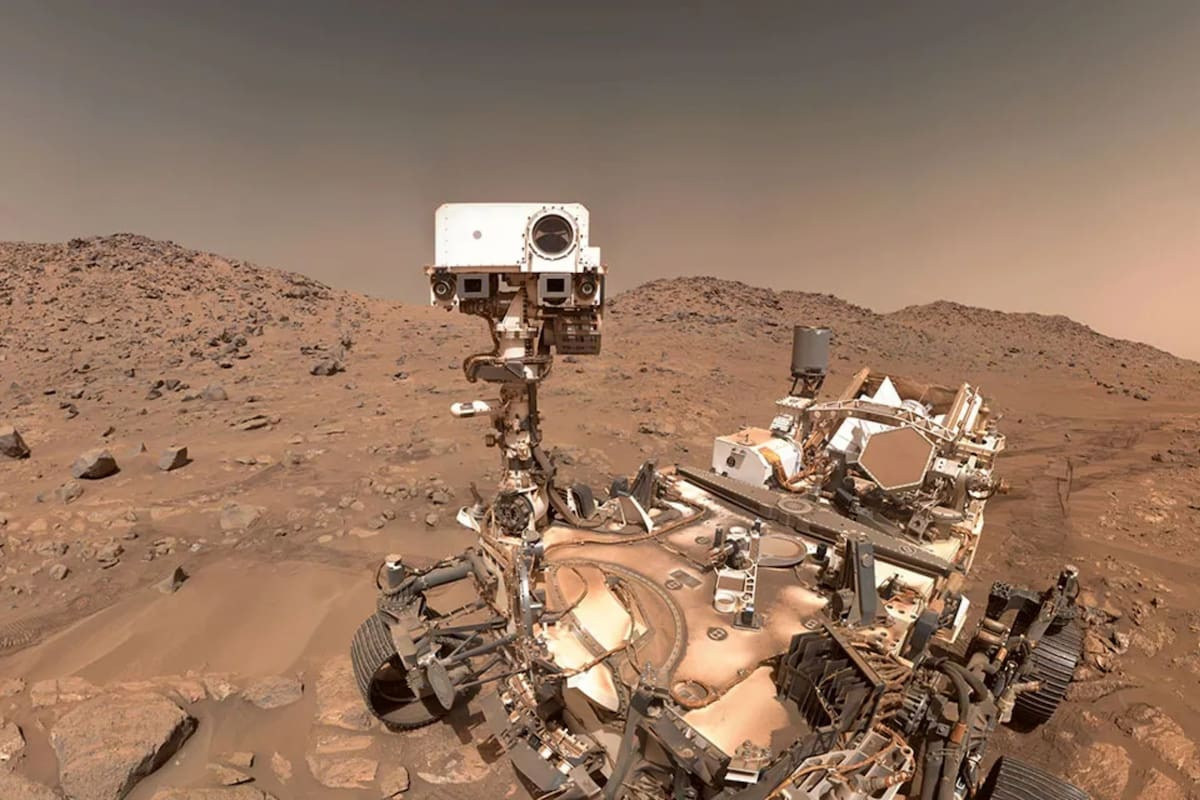
More than 3.5 billion years ago, Mars's Jezero Crater hosted a lake formed by overflowing rivers, a pivotal discovery confirmed by NASA that could reshape our understanding of extraterrestrial life. The Perseverance robotic explorer, which landed in this region, found ancient sediments suggesting a dynamic watery past, offering fertile ground for the search for biosignatures.
Scientists detected clear indications that water transported clay minerals into Jezero Crater. This type of sediment is particularly valuable because it has the capacity to preserve chemical signals relevant to the search for ancient life. Current research focuses on studying the lake shore sediments to thoroughly understand how this Martian region formed and evolved.
"It's the closest we've been to discovering life on Mars," stated Sean Duffy, then interim NASA administrator, in September 2025.
Jezero Crater was not chosen at random. Before the Perseverance rover's launch on July 30, 2020, scientists worldwide evaluated over 60 potential landing and exploration sites on the Red Planet. They ultimately selected Jezero due to its unique characteristics, making it an ideal location for exploration and sample collection.
During the boreal summer of 2024, the robotic explorer made a significant discovery: a complex rock they named Cheyava Falls. This rock contained organic material, and its composition yielded clues compatible with a possible ancient biosignature on Mars. The conclusions of this finding were published in the journal Nature in September 2025, generating considerable excitement within the scientific community.
NASA's Perseverance rover continues its tireless work, collecting over two dozen geologically diverse rock samples. Among these are some that appear to contain possible biosignatures, which are chemical signals associated with ancient biological processes. The hope is that, in the future, this valuable collection of material can be transported to Earth for much deeper and more detailed analysis in terrestrial laboratories.
However, Perseverance's mission extends beyond mere exploration and sample collection. It also served as a platform to test key technologies for future crewed missions. For instance, the flight of a helicopter on Mars was achieved, an unprecedented engineering feat, and the in-situ production of oxygen was demonstrated.
A device called MOXIE, installed on the explorer, is responsible for generating oxygen directly from the Martian atmosphere. This technology is vital, as it could provide breathable air for astronauts and rocket fuel for future human missions. Since Perseverance landed on Mars in 2021, MOXIE has generated a total of 122 grams of oxygen, an amount comparable to what a small dog breathes in ten hours, according to a NASA report.
At its peak performance, MOXIE was capable of producing 12 grams of oxygen per hour, doubling initial expectations. These tests represent a giant leap towards the feasibility of crewed missions to Mars, not only for astronaut survival but also for ensuring a propulsion source that allows them to return to Earth.
The ability to produce oxygen on Mars dramatically reduces the amount of resources a human mission would need to transport from Earth, making Red Planet exploration more sustainable and ambitious. MOXIE's success paves the way for humans to set foot on Mars, utilizing the planet's own resources for their survival and return.

Article topics
Related articles

James Webb Telescope Discovers Water Vapor on Exoplanet TOI-421 b
NASA's space telescope made an unprecedented finding on TOI-421 b, a sub-Neptune with a surprisingly clear atmosphere, potentially reshaping our understanding of planetary formation.

NASA Enhances Asteroid Detection and Deflection Capabilities
The US space agency advances planetary defense techniques following the successful DART mission and the upcoming NEO Surveyor observatory.
Unexpected Garnet Discovery in Martian Meteorite Reveals Mars' Geological History
Researchers have found garnet grains, a mineral never before observed on the Red Planet, inside a Martian meteorite, offering new insights into its 4.5-billion-year geological past.
Latest news
View all
Apple Raises Prices for Mac, iPad, Vision Pro Due to Component Costs
The Cupertino giant increases the value of several key products, with some hikes exceeding 20%, driven by a sharp rise in memory and critical component costs.

Fox Acquires Roku to Boost Free Streaming Strategy
Fox Corporation has announced its acquisition of the Smart TV platform Roku for $160 per share, aiming to consolidate its presence in the competitive streaming market and direct users to its content.

M5 Ultra Mac Studio May Launch in 2026 With Up to 768GB RAM
Apple plans to release a new Mac Studio with the M5 Ultra chip, but its debut has been delayed due to memory issues and price increases.
Comments (0)
No comments yet. Be the first!
Only registered readers can comment.