
James Webb Reveals Small Red Dots Key to Supermassive Black Hole Origins
A discovery by the University of Texas at Austin, published in "The Astrophysical Journal", could reshape our understanding of these cosmic giants.
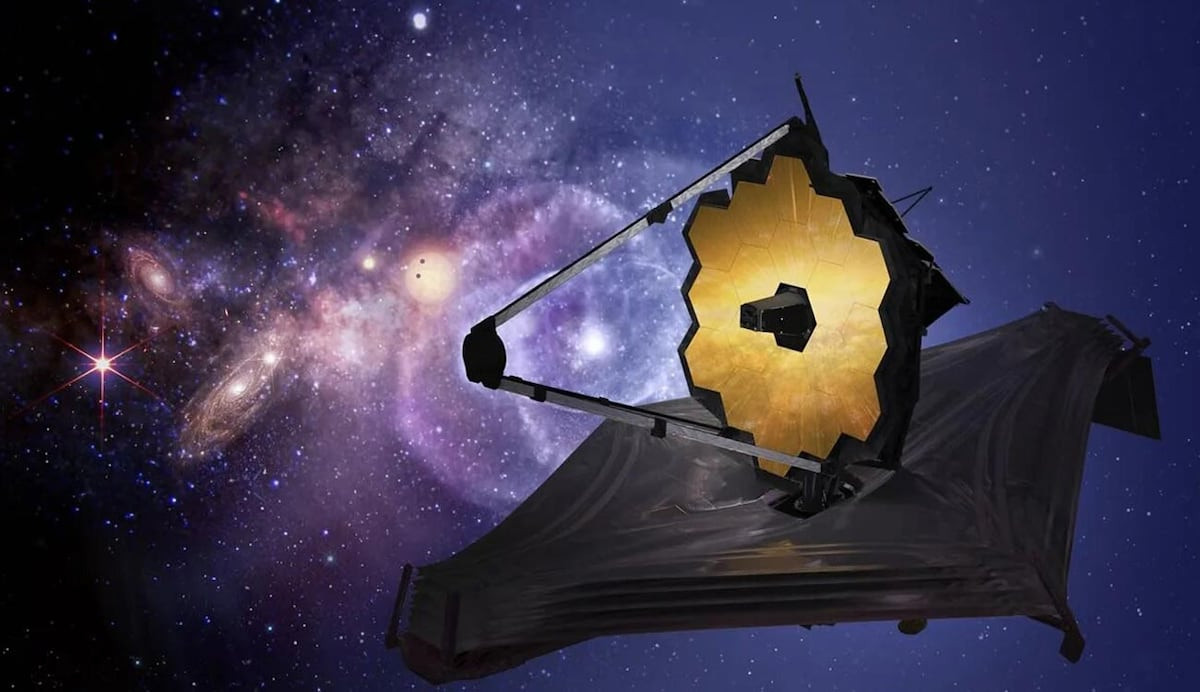
The James Webb Space Telescope (JWST) recently identified small red dots in the early universe. This groundbreaking discovery, led by the University of Texas at Austin and published in "The Astrophysical Journal", could reshape our understanding of supermassive black hole origins. These compact, enigmatic light sources provide crucial evidence for the rapid formation of massive objects shortly after the Big Bang.
These red dots stand out due to their intense infrared light and a size significantly smaller than typical galaxies. Analyses suggest they correspond to regions with high gas density. Unlike young galaxies, they lack a significant stellar population. Researchers believe these "Small Red Dots" are powered by supermassive black holes, enveloped in a massive cocoon of dense gas.
This study proposes a fascinating hypothesis: these objects represent an advanced stage in the formation of supermassive black holes through the direct collapse of vast primitive gas clouds. This idea, known as the "heavy seed" hypothesis, does not require the prior death of massive stars. It differs from the traditional model, which attributes these phenomena's origin to the gradual growth of stellar remnants, called "light seeds".
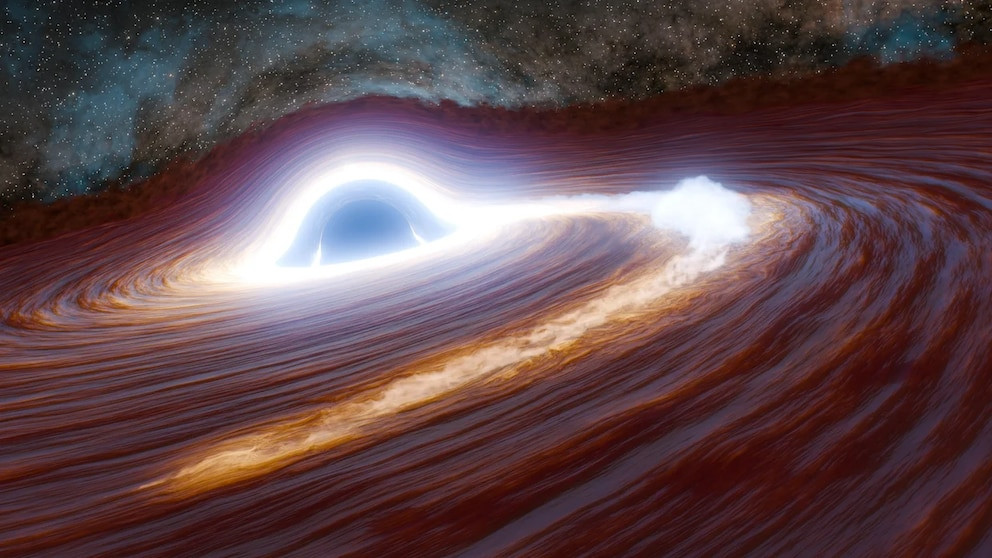
Computational simulations bolster the direct collapse theory. If the origin were primarily from stellar remnants, we should observe a greater number of these points. However, the fewer detections by Webb support the hypothesis that a gas cloud can form a black hole 10,000 to one million times the solar mass very quickly. "Finding black holes in the early universe is quite a surprise because it goes against the standard model of how the universe builds its structure from small pieces!" explained Volker Bromm, professor of astronomy.
Finding black holes in the early universe is quite a surprise because it goes against the standard model of how the universe builds its structure from small pieces.
To unravel these complex processes, research teams relied on advanced supercomputing techniques. Models like A-SLOTH proved essential. Calculations performed on supercomputers such as Lonestar6 and Stampede3, at the Texas Advanced Computing Center, were instrumental. These allowed analysis of James Webb data and simulation of universe conditions less than half a million years after the Big Bang.
This discovery not only redefines our view of the early cosmos but also underscores the power of modern technology. The major challenge now is, in essence, a supercomputing problem. We must understand the data coming from the JWST about the earliest galaxies. This will allow us to advance through time from the primordial universe.
Article topics
Related articles
NASA Reveals New Path for Earth's Essential Life Elements
A recent study, published in Science Advances, uncovers how early Earth may have received phosphorus and nitrogen, highlighting Jupiter's critical role.
NASA's Maven Mars Orbiter Declared Out of Service After Six Months of Silence
Following an anomaly that disrupted its orbit and depleted its batteries, the Maven spacecraft, vital for understanding Mars' atmosphere, has ended its active mission. Its scientific data remains an invaluable legacy.

NASA Space Robotics Challenge
NASA invites U.S. researchers to submit proposals for experiments using a robotic arm that will be sent to low Earth orbit as part of the Fly Foundational Robots mission.
Latest news
View all
Stuntman Hollywood: Returns After 19 Years to PS5, Xbox Series, and PC
The iconic action and vehicular stunt franchise makes its comeback courtesy of Saber Interactive, promising a dose of nostalgia and adrenaline for the new generation.

Windows Drops NTLM: Microsoft Boosts Security with Kerberos
Microsoft is taking a crucial step to bolster security in Windows 11, announcing the deprecation of NTLM, its oldest authentication protocol, in favor of Kerberos.
Google Launches Gemma 4 12B: Local AI for Your Laptop with 16GB RAM
Google's new artificial intelligence model aims to democratize access to generative AI, allowing it to run on average consumer computers.
Comments (0)
No comments yet. Be the first!
Leave a comment