
China Leads the Hypersonic Race with a Revolutionary All-Speed Engine
China has unveiled a prototype "contra-rotary ramjet engine" capable of propelling aircraft from takeoff to hypersonic speeds beyond Mach 6, marking a significant milestone after three decades of research. This breakthrough aims to overcome the limitations of traditional propulsion systems, offering a unified and more efficient solution for the future of military aviation.
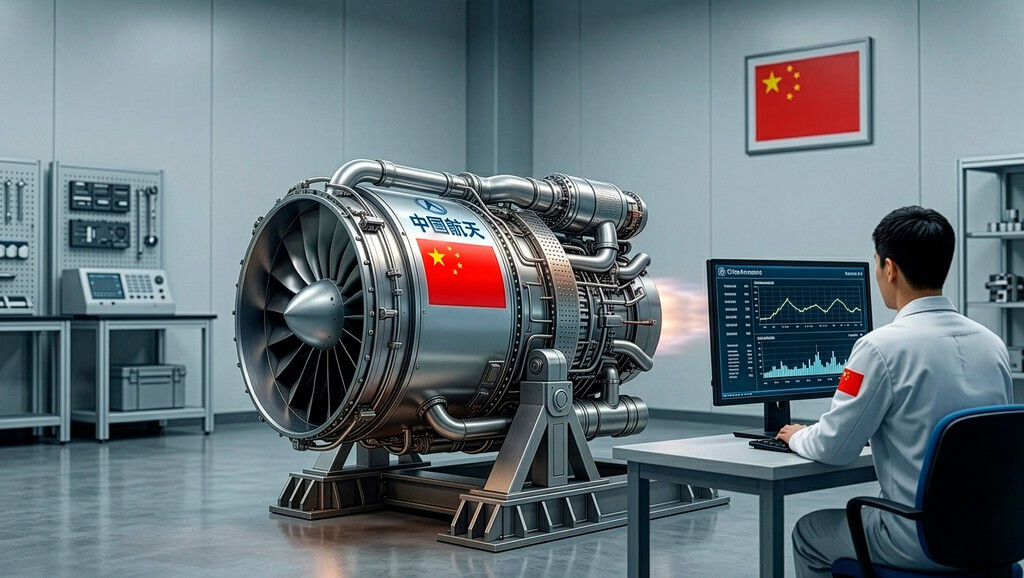
For decades, the pursuit of hypersonic flight has represented one of the most complex and ambitious challenges in aerospace engineering. It's not merely about designing materials capable of withstanding extreme temperatures or aerodynamics that minimize drag; it's about solving the fundamental enigma of propulsion: how to maintain a stable and efficient engine system from takeoff to speeds exceeding Mach 6. China has been deeply engaged in this technological race since the mid-1990s, and now, after more than thirty years of research and development, it claims to have completed a prototype that promises to revolutionize the field. This innovative design, described as a “contra-rotary ramjet engine,” is conceived to operate continuously across this vast speed range, eliminating the need to switch between different propulsion systems mid-flight.
The Challenge of Unified Hypersonic Propulsion
The traditional solution for achieving high-speed and hypersonic flight has historically involved combining two distinct propulsion systems, each optimized for a specific speed regime. On one hand, turbine engines, similar to those used in current commercial aircraft, are essential for takeoff and the initial phases of flight, providing the necessary thrust up to speeds of approximately Mach 3. On the other hand, ramjet engines (and their variants like scramjets) come into play at much higher speeds, as they can only operate efficiently when air enters them at supersonic velocity. While this division of labor partially solves the problem of propulsion across different regimes, it introduces its own significant complications. Researchers point out that this dual-approach carries unnecessary mass, as one of the engines remains inactive for much of the flight, and adds considerable technical complexity at the critical moment of transition between systems—a process that can become unstable during demanding, high-stress phases of flight.
China's Innovation: An Engine for All Speeds
The research team, affiliated with the prestigious Chinese Academy of Sciences (CAS) and led by Professor Xu Jianzhong, has addressed these limitations with a radically different proposal. The core of their innovation lies in the engine's compressor, which departs from conventional designs. Instead of a single set of blades, this engine employs two sets that rotate in opposite directions: one for the high-pressure stage and another for the low-pressure stage. This contra-rotating configuration not only significantly reduces the centrifugal forces acting on the internal components, thereby improving durability and safety, but also optimizes the rotational efficiency of the compressor. Furthermore, the design introduces an unconventional concept in airflow management: instead of attempting to minimize shock waves, as is common in aerodynamic engineering, this engine actively harnesses them to compress the airflow. This ingenious strategy not only enhances compression but also contributes to a notable reduction in the engine's size and weight, a critical factor for any advanced aerospace application.
Three Decades of Development and Experimental Verification
The path to this prototype has been neither quick nor easy. Professor Xu Jianzhong's vision for hypersonic propulsion began to take shape in the mid-1990s, and by 2000, he had already outlined the fundamental concept of the contra-rotating compressor. For years, the project advanced with consistent dedication until, in 2009, it received crucial institutional backing that enabled the construction of the prototype. This milestone marked the beginning of an intensive phase of testing and verification. The CAS team asserts that the prototype has now been completed and experimentally verified, demonstrating its viability in controlled laboratory environments. However, it is important to note that the development is still in a preliminary phase. The next critical steps include adapting this engine to various aerial platforms, both for advanced fighters and hypersonic missiles, and subjecting it to rigorous real-world flight tests. These tests will be fundamental to validating its behavior and performance outside controlled laboratory conditions, confronting it with the inherent challenges of atmospheric flight.
Strategic Implications and the Future of Defense
The culmination of this hypersonic engine prototype carries profound strategic implications, especially in the context of the escalating global hypersonic arms race. An engine capable of operating efficiently and continuously from takeoff to speeds exceeding Mach 6 could radically transform the design and capabilities of military aircraft and missiles. It would enable the development of faster, more agile fighters, capable of intercepting or evading threats with unprecedented effectiveness, and hypersonic missiles that would be extremely difficult to detect and counter with current defense systems. This breakthrough positions China at the forefront of hypersonic propulsion technology, solidifying its leadership in a field deemed crucial for national security and power projection in the 21st century. While significant challenges remain before its large-scale implementation, the experimental verification of this prototype represents a monumental step towards the future of aviation and defense.
Article topics
Related articles

NASA Reveals New Path for Earth's Essential Life Elements
A recent study, published in Science Advances, uncovers how early Earth may have received phosphorus and nitrogen, highlighting Jupiter's critical role.
NASA's Maven Mars Orbiter Declared Out of Service After Six Months of Silence
Following an anomaly that disrupted its orbit and depleted its batteries, the Maven spacecraft, vital for understanding Mars' atmosphere, has ended its active mission. Its scientific data remains an invaluable legacy.
NASA Space Robotics Challenge
NASA invites U.S. researchers to submit proposals for experiments using a robotic arm that will be sent to low Earth orbit as part of the Fly Foundational Robots mission.
Latest news
View all
Stuntman Hollywood: Returns After 19 Years to PS5, Xbox Series, and PC
The iconic action and vehicular stunt franchise makes its comeback courtesy of Saber Interactive, promising a dose of nostalgia and adrenaline for the new generation.

Windows Drops NTLM: Microsoft Boosts Security with Kerberos
Microsoft is taking a crucial step to bolster security in Windows 11, announcing the deprecation of NTLM, its oldest authentication protocol, in favor of Kerberos.

Google Launches Gemma 4 12B: Local AI for Your Laptop with 16GB RAM
Google's new artificial intelligence model aims to democratize access to generative AI, allowing it to run on average consumer computers.
Comments (0)
No comments yet. Be the first!
Leave a comment