
Ubuntu 26.04 LTS: Raising the Security Bar for the Next Decade
Ubuntu 26.04 LTS redefines operating system security, not just by adding features, but by strengthening every layer of the system from its foundation. This release introduces a new security paradigm, featuring hardware-backed encryption, post-quantum cryptography, and a unified control center, marking a milestone for enterprise and mission-critical deployments.
In the fast-paced world of technology, security is a constant and evolving concern. With every new threat, operating systems must adapt and strengthen. Ubuntu 26.04 LTS, Canonical's latest Long Term Support release, emerges as a robust answer to these challenges, setting a new and significantly higher default security floor for the next decade of Linux deployments. This version doesn't just add features; it raises the security floor across every layer of the system simultaneously, without breaking existing deployments or demanding manual intervention – a remarkable achievement in cybersecurity.
Ubuntu 26.04 LTS's primary focus has been on reinforcing the heart of security: the defaults. By doing so, Canonical has managed to strengthen Ubuntu's security in new and profound ways. From desktops and servers to confidential VMs, cloud images, and edge systems, this release is designed to be the foundational pillar upon which organizations will build their secure infrastructures. Below, we will explore the most notable new features that make Ubuntu 26.04 LTS one of the most securely designed LTS releases ever.
TPM-backed Full Disk Encryption (FDE): Production-Ready
One of the most anticipated and crucial features reaching general availability with Ubuntu 26.04 LTS is TPM-backed Full Disk Encryption (FDE). While this capability was introduced in earlier releases behind an experimental flag, with 26.04 LTS, Canonical has made it operationally robust and enterprise-ready. The Trusted Platform Module (TPM) is a cryptographic security chip that stores encryption keys and protects system integrity, ensuring that the disk can only be decrypted in a trusted system state. This is fundamental for protecting sensitive data against unauthorized access, even if the device falls into the wrong hands.
The work in this release has meticulously focused on the failure modes that matter in production. This includes predictable recovery-key handling during firmware updates, which is now surfaced before a potentially breaking reboot. Furthermore, known incompatibilities, such as those related to Absolute/Computrace, are explicitly documented and must be accounted for by administrators. Kernel module requirements for certain storage configurations are also clearly defined. This level of detail and foresight is what production readiness looks like: fewer undefined states and fewer surprises during deployment and long-term operation.
Security Center: A Control Plane for Continuous Security
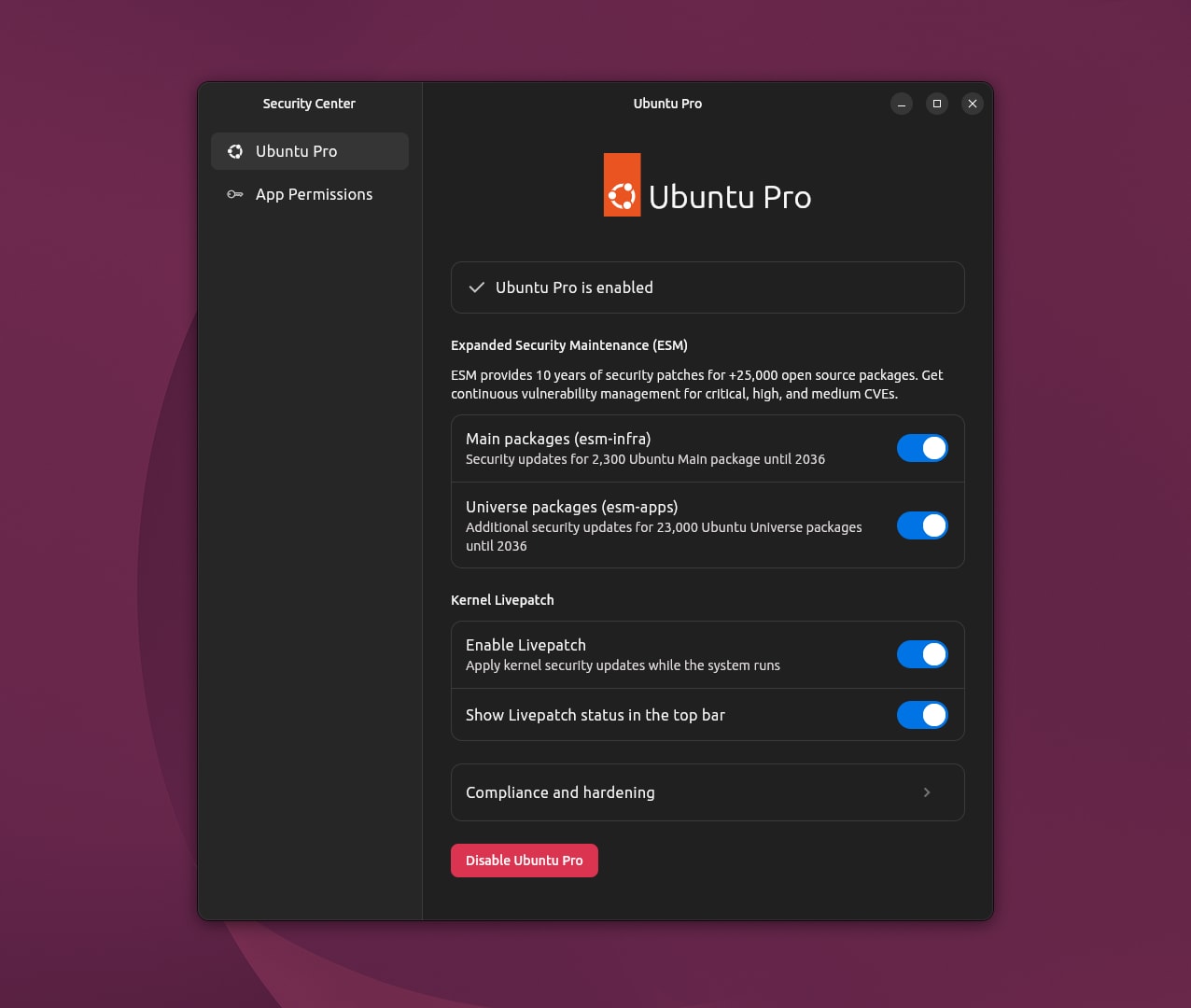
Historically, key security decisions, such as disk encryption or secure boot posture, were made at installation time and rarely revisited. Ubuntu 26.04 LTS fundamentally changes this philosophy. The new Security Center transforms security from a one-time event into a continuous lifecycle responsibility. Now, critical platform protections are surfaced in a way that makes them inspectable and manageable long after the initial deployment.
Administrators can easily review and manage the TPM-backed Full Disk Encryption state, recovery mechanisms, Secure Boot status, and disk protection configuration. This evolution is a fundamental shift: security is no longer a checkbox during setup but an integral and visible part of system operation. For managed desktop fleets and enterprise environments, this significantly reduces blind spots and increases auditability, enabling a proactive and adaptable security posture.
Post-Quantum Cryptography and Rejection of Legacy TLS
Looking towards the future, Ubuntu 26.04 LTS positions itself at the forefront with cryptographic defaults that are post-quantum aware. As quantum computing advances, current cryptography could become vulnerable. By integrating "post-quantum" algorithms and practices, Ubuntu prepares to protect data against future threats, ensuring long-term confidentiality and integrity. This foresight is crucial for infrastructures requiring lasting security.
In the realm of web communication, web servers in Ubuntu 26.04 LTS now reject legacy TLS (Transport Layer Security) versions by default. TLS 1.0 and 1.1, while once standards, are now considered insecure and vulnerable to various attacks. By disabling them by default, Ubuntu 26.04 LTS forces the use of more modern and secure TLS versions (such as TLS 1.2 and 1.3), significantly enhancing the security of encrypted communications and protecting information transmitted across the web. This measure, while potentially requiring adjustments in environments with very old systems, is an essential step to maintain the integrity of the security chain.
"Oxidizing" Critical Components and Secure Identity Services
A continuous and significant effort in Ubuntu 26.04 LTS is the "oxidation" of security-sensitive parts, which involves rewriting critical components in Rust. Rust is a programming language known for its memory safety guarantees, which helps prevent entire classes of vulnerabilities common in languages like C/C++, such as buffer overflows and null pointer errors. The inclusion of rust-coreutils and sudo-rs implementations as defaults is a testament to this commitment, making fundamental system tools inherently more secure and resilient to attacks.
Complementing this, identity services in Ubuntu 26.04 LTS refuse to run as root. This principle of "least privilege" is a cornerstone of security. By preventing identity services from operating with maximum privileges, the attack surface is drastically reduced. If an attacker were to compromise an identity service, the potential damage would be significantly limited, as they would not have full system access. This measure reinforces the overall system's resilience against privilege escalation.
Firmware, Secure Boot, and an Auditable Control Plane
The security of Ubuntu 26.04 LTS extends to the lowest layer of the system with end-to-end hardened firmware and secure boot. Secure Boot ensures that only trusted software can load during the startup process, protecting against rootkits and malware that attempt to compromise the system before the operating system fully loads. Firmware hardening complements this, ensuring that the underlying hardware is also resistant to tampering.
Finally, a comprehensive control plane makes all these security enhancements visible, manageable, and auditable long after deployment. This unified control center not only allows administrators to configure and monitor security but also provides the logs and tools necessary for compliance audits and forensic analysis. This visibility and manageability are essential for maintaining a robust security posture and for complying with regulations in enterprise and regulated environments.
Conclusion
Ubuntu 26.04 LTS represents a qualitative leap in the security of Linux operating systems. By focusing on strengthening the foundations and defaults, and by introducing innovations such as production-ready TPM-backed FDE, post-quantum cryptography, and a continuous security control center, Canonical has delivered an exceptionally robust platform. For organizations seeking a secure and reliable foundation for their Linux deployments over the next decade, Ubuntu 26.04 LTS is not just an option, but the strategic choice to build a safer and more resilient digital future.
Article topics
Related articles

Windows Drops NTLM: Microsoft Boosts Security with Kerberos
Microsoft is taking a crucial step to bolster security in Windows 11, announcing the deprecation of NTLM, its oldest authentication protocol, in favor of Kerberos.

Chrome Bolsters Security with DBSC Against Cookie Theft
Google Chrome has rolled out a new DBSC feature, linking sessions to your hardware to protect accounts from credential theft attacks.

Roku's home screen gets an AI-powered refresh for 2026
Roku is rolling out a significant update to its main interface, promising a more personalized experience with integrated advertising.
Latest news
View all
Stuntman Hollywood: Returns After 19 Years to PS5, Xbox Series, and PC
The iconic action and vehicular stunt franchise makes its comeback courtesy of Saber Interactive, promising a dose of nostalgia and adrenaline for the new generation.

NASA's Maven Mars Orbiter Declared Out of Service After Six Months of Silence
Following an anomaly that disrupted its orbit and depleted its batteries, the Maven spacecraft, vital for understanding Mars' atmosphere, has ended its active mission. Its scientific data remains an invaluable legacy.

NASA Reveals New Path for Earth's Essential Life Elements
A recent study, published in Science Advances, uncovers how early Earth may have received phosphorus and nitrogen, highlighting Jupiter's critical role.
Comments (0)
No comments yet. Be the first!
Leave a comment