
Humanoid robot glides on ice and impresses with its balance
Unitree Robotics showcased a humanoid robot that now skates on inline skates and ice, demonstrating advances in mobility and dynamic control.
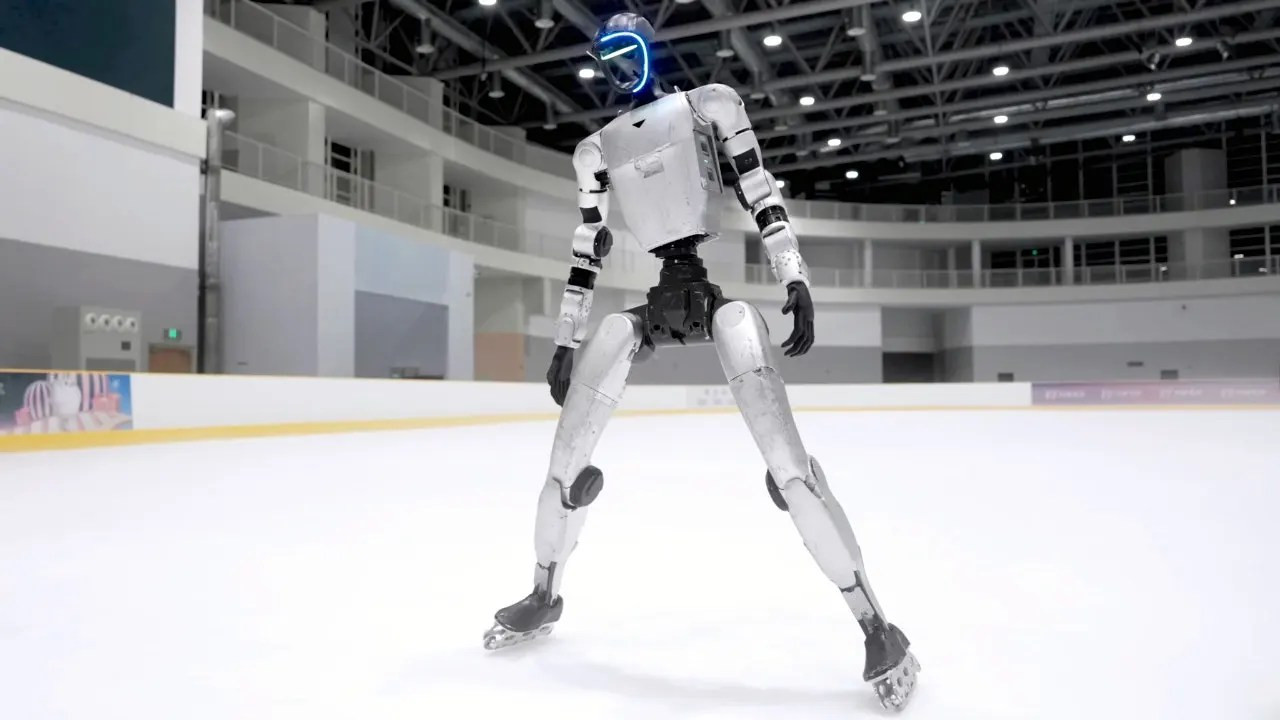
Humanoid robots continue to expand their abilities, reaching a milestone that once seemed exclusive to humans. Chinese company Unitree Robotics released a video showing its G1 robot skating on inline skates and ice with impressive balance and coordination. The footage captures the robot performing complex movements while maintaining stability on surfaces that challenge any machine. The G1 not only moves on wheels or ice but also executes turns, quick direction changes, pirouettes, and even a somersault without losing control.

This development marks a significant step forward in humanoid robot design, a field that has seen rapid progress in mobility, artificial intelligence, and dynamic control in recent years. In the video, the robot starts moving on two integrated wheels, leaning forward and moving its arms to keep balance. The scene resembles a person skating more than a traditional machine.
Later, the humanoid performs more complex maneuvers, including fast spins and a complete flip that lands stably before continuing. It then uses regular inline skates, demonstrating even greater precision by changing directions, lifting a leg while turning, and performing small dance-like steps without losing stability. One of the most striking moments occurs on ice, where the G1 glides smoothly, executing continuous turns similar to an artistic skater, all without falls or abrupt stops.
Why is this breakthrough important? Maintaining dynamic balance has always been a major challenge in humanoid robotics. Walking, running, or reacting to sudden terrain changes requires precise real-time calculations. On unstable surfaces like ice, the difficulty rises sharply, as even minor errors can cause falls. The G1’s secret lies in its hybrid mobility system, which combines wheels and humanoid joints within a single design. This allows it to switch between fast movements and adaptable actions based on the environment.
According to Unitree, this approach aims to merge the energy efficiency and speed of wheeled robots with the adaptability of legged robots. Practically, this results in a humanoid capable of moving swiftly on flat surfaces and maintaining balance in complex situations, opening new horizons for advanced robotic mobility.
Article topics
Related articles

Windows Drops NTLM: Microsoft Boosts Security with Kerberos
Microsoft is taking a crucial step to bolster security in Windows 11, announcing the deprecation of NTLM, its oldest authentication protocol, in favor of Kerberos.

Chrome Bolsters Security with DBSC Against Cookie Theft
Google Chrome has rolled out a new DBSC feature, linking sessions to your hardware to protect accounts from credential theft attacks.

Roku's home screen gets an AI-powered refresh for 2026
Roku is rolling out a significant update to its main interface, promising a more personalized experience with integrated advertising.
Latest news
View all
Stuntman Hollywood: Returns After 19 Years to PS5, Xbox Series, and PC
The iconic action and vehicular stunt franchise makes its comeback courtesy of Saber Interactive, promising a dose of nostalgia and adrenaline for the new generation.
NASA's Maven Mars Orbiter Declared Out of Service After Six Months of Silence
Following an anomaly that disrupted its orbit and depleted its batteries, the Maven spacecraft, vital for understanding Mars' atmosphere, has ended its active mission. Its scientific data remains an invaluable legacy.

NASA Reveals New Path for Earth's Essential Life Elements
A recent study, published in Science Advances, uncovers how early Earth may have received phosphorus and nitrogen, highlighting Jupiter's critical role.
Comments (0)
No comments yet. Be the first!
Leave a comment